
In many contact centers, the payment moment is still treated as a technical problem rather than a customer experience problem.
A customer calls.
An agent answers.
A conversation begins.
The customer explains the issue, asks a question, receives support and finally reaches the point of payment.
At that precise moment — when trust has been created and the intent to pay is at its highest — many companies interrupt the journey.
They send a payment link.
The customer is asked to leave the call, open a message, click a link, complete the payment on another screen and then return mentally, and sometimes physically, to the original conversation.
This is not a minor operational detail.
It is channel switching at the worst possible moment.
For years, companies have accepted this model because they believed that secure phone payments were too complex, too expensive, too difficult to certify under PCI-DSS or too disruptive to implement inside existing contact center infrastructure.
But the market is changing.
The future of contact center payments is not simply about sending more links. It is about enabling secure, compliant and frictionless payments inside the voice channel.
That is the strategic role of Pay by Call.
The Problem With Channel Switching in Contact Center Payments
Pay by Link has clear value in many digital journeys.
It can be useful when the customer is already in a digital environment, when the payment is asynchronous, or when the company wants to send a remote payment request after a conversation.
But in a live contact center interaction, Pay by Link can introduce unnecessary friction.
The customer is already speaking with the company.
The agent is already guiding the process.
The intent to pay already exists.
The trust relationship is already active.
Sending a link at that moment can break the natural flow of the conversation.
The customer may not receive the link immediately.
The customer may not trust the link.
The customer may not want to switch devices.
The customer may be uncomfortable entering card details on a mobile screen while still speaking on the phone.
The customer may abandon the transaction before completing it.
In ecommerce, friction reduces conversion.
In contact centers, friction reduces payment completion.
The difference is that, in the contact center, the company often creates the friction itself by moving the customer away from the channel where the relationship is already working.
Voice Is Still a Strategic Payment Channel
The voice channel has not disappeared.
In fact, it remains one of the most important channels for complex, sensitive or high-intent customer interactions.
Customers call when they need reassurance.
They call when the transaction is important.
They call when the situation is urgent.
They call when they need an explanation.
They call when they prefer a human voice to a digital form.
This is especially relevant in sectors such as utilities, airlines, insurance, healthcare, public administration, debt collection, travel, hospitality, transport and large enterprise customer service operations.
In these environments, the contact center is not just a support channel.
It is a conversion channel.
It is a trust channel.
It is a payment channel.
The real challenge is not whether voice can still be relevant. The challenge is how to make voice payments secure, compliant and scalable without exposing cardholder data or increasing PCI-DSS scope.
This is where a voice-native PCIaaS model becomes essential.
What Is PCIaaS in the Voice Channel?
PCIaaS — PCI Compliance as a Service — is the idea of transforming a complex PCI-DSS compliance burden into a specialized, secure and usage-based service layer.
For large companies, PCI-DSS compliance in the contact center can become a heavy internal project.
It may require technical redesign, security consultancy, audit preparation, call recording reviews, telephony analysis, agent process changes, internal controls, recurring certification work and coordination between multiple vendors.
The cost is not only financial.
It is operational.
It consumes time, management attention and technical resources.
Pay by Call approaches the problem differently.
The PaybyCall platform acts as a PCIaaS layer specifically designed for secure payments in the voice channel.
Instead of forcing the enterprise to rebuild its entire payment or contact center architecture, PaybyCall provides a certified, voice-native payment environment that can integrate with the company’s existing ecosystem.
This means the company can reduce PCI-DSS exposure in the contact center while keeping its current providers.
No PSP replacement.
No PBX replacement.
No CCaaS replacement.
No forced migration of the contact center stack.
The PCI complexity is externalized into a specialized payment-grade voice platform.
The result is strategically important: part of the PCI-DSS burden can move from a heavy internal CAPEX or audit-driven project into a discreet, variable, usage-based OPEX model.
The Strategic Value: Keep Your Existing PSP, PBX and CCaaS
One of the strongest advantages of Pay by Call is interoperability.
Many enterprise payment solutions create a hidden cost: they require the company to change part of its existing ecosystem.
A new PSP.
A new payment gateway.
A new contact center platform.
A new telephony provider.
A new agent desktop.
A new workflow.
For large organizations, this can become a major barrier.
Most enterprises do not want to replace systems that already work. They want to solve the payment security problem without creating a larger transformation problem.
Pay by Call is built with that principle in mind.
The PaybyCall platform is designed to integrate with existing PSPs, acquiring environments, PBX systems, CCaaS platforms and contact center architectures.
This is a critical difference.
Pay by Call does not try to become the company’s general payment gateway.
It does not try to replace the existing PSP.
It does not try to replace the company’s contact center technology.
It acts as a specialized secure voice payment layer that connects with the infrastructure already in place.
This makes adoption faster, less disruptive and more realistic for large enterprises and public-sector organizations.
Agent-Guided Payments With DTMF Masking
In many payment journeys, the human agent remains valuable.
The agent explains the process.
The agent reassures the customer.
The agent helps resolve doubts.
The agent keeps the transaction moving.
The goal should not always be to remove the agent from the payment journey.
The goal is to prevent the agent from seeing, hearing, processing or storing sensitive cardholder data.
That is where agent-guided payments with DTMF masking become powerful.
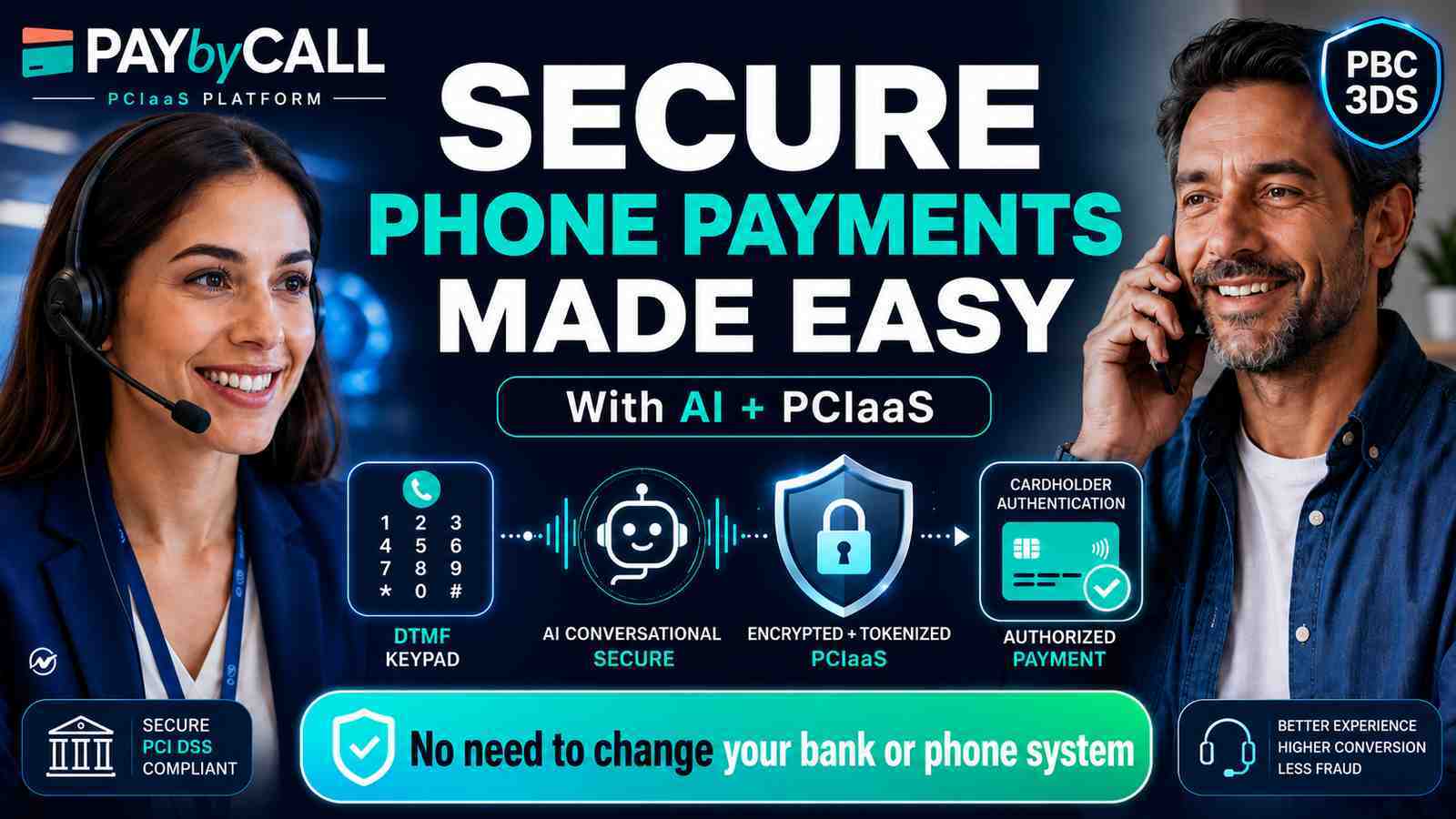
With a secure DTMF masking process, the customer can enter card data using the telephone keypad while staying inside the call. The agent can continue guiding the conversation, but the sensitive card data does not enter the agent environment.
The tones are masked.
The card data is protected.
The customer remains in the voice channel.
The agent remains available.
The company reduces PCI-DSS exposure.
The payment can be completed without sending the customer away.
This model preserves the value of human assistance while reducing compliance risk.
It is not only more secure.
It is also more natural for the customer.
Conversational AI: Empathy Without Compromising PCI Security
Conversational AI can significantly improve the payment experience in the contact center.
But only if it is implemented correctly.
Customers often need reassurance during a phone payment. They may want to know whether the process is secure, whether the agent can see their card number, whether the transaction has been completed or what happens if they enter a wrong digit.
A conversational AI assistant can support this journey with clear, consistent and empathetic guidance.
It can explain the payment steps.
It can reduce anxiety.
It can help the customer understand what is happening.
It can confirm progress.
It can support the agent or partially automate the experience.
However, there is a critical architectural principle:
General-purpose AI should not become the place where sensitive cardholder data is exposed.
The right model is not to send payment data into an AI environment.
The right model is to combine conversational intelligence with a secure, certified, payment-grade PCI environment.
In Pay by Call’s vision, conversational AI can guide and reassure the customer, while the PaybyCall PCIaaS platform executes the payment securely inside the protected voice payment environment.
The AI improves the experience.
The PCIaaS platform protects the transaction.
This distinction is essential for the future of secure Voice Commerce.
PBC 3DS: Strong Authentication Without Leaving the Call
Another major challenge in phone payments is authentication.
In digital ecommerce, 3D Secure has become a familiar mechanism for strong customer authentication. But in the voice channel, many companies still rely on workarounds that force the customer into another channel.
This often means sending a payment link.
But that creates the same problem again: channel switching.
PBC 3DS is Pay by Call’s answer to this challenge.
PBC 3DS is designed to bring strong authentication into the voice payment journey without forcing the customer to abandon the call.
The strategic idea is simple:
If the customer journey starts in the voice channel, the payment and authentication experience should also be completed inside the voice channel whenever possible.
This is especially important for contact center environments where the agent, the call and the conversation are central to the transaction.
PBC 3DS helps make secure voice payments more consistent with modern authentication expectations, while preserving the continuity of the customer journey.
Pay by Link vs Pay by Call: A Different Payment Philosophy
The difference between Pay by Link and Pay by Call is not only technical.
It is philosophical.
Pay by Link moves the customer away from the conversation.
Pay by Call keeps the customer inside the voice journey.
Pay by Link depends on another device, another screen and another action.
Pay by Call completes the payment where the customer already is.
Pay by Link can create abandonment after the intent to pay has already been generated.
Pay by Call is designed to reduce friction at the moment of highest intent.
Pay by Link is useful for many digital payment scenarios.
Pay by Call is purpose-built for secure payments inside the voice channel.
The question is not whether Pay by Link has value.
The question is whether Pay by Link should be the default solution when a customer is already speaking with an agent and ready to pay.
In many contact center environments, the answer is no.
Why Focused VoiceTech Matters in Fintech
Pay by Call is a focused VoiceTech company inside the fintech ecosystem.
That focus matters.
The company does not try to compete as a generalist payment gateway.
It does not try to replace PSPs.
It does not try to replace CCaaS providers.
It does not try to control the entire enterprise technology stack.
Its focus is much more specific:
To make phone payments secure, compliant, intelligent and frictionless inside the existing voice ecosystem.
That specialization creates depth.
Depth in PCI-DSS.
Depth in IVR.
Depth in DTMF masking.
Depth in PSP interoperability.
Depth in contact center architecture.
Depth in public-sector and enterprise requirements.
Depth in secure Voice Commerce.
Large companies do not always need another broad platform.
Sometimes they need a specialist layer that solves a painful problem with precision.
That is where Pay by Call can create strategic value for enterprises, public administrations, BPOs, PSPs and contact center operators.
From PCI Burden to Variable OPEX
For many organizations, contact center PCI-DSS compliance has traditionally been treated as a cost center.
A recurring burden.
A project driven by audit pressure.
A compliance obligation.
But with a PCIaaS model, the economics can change.
Instead of managing the full complexity internally, the company can rely on a specialized certified platform that delivers secure payment capabilities as a service.
This can transform part of the compliance burden into a variable operating cost linked to actual usage.
That is a very different model.
It is more flexible.
It is easier to scale.
It can reduce internal friction.
It can accelerate deployment.
It can avoid unnecessary vendor replacement.
It can align cost with transaction volume.
For CFOs, CIOs, CISOs, contact center directors and customer experience leaders, this is not just a technical improvement.
It is an operational and financial improvement.
The Future of Contact Center Payments Is Secure Voice Commerce
The future of contact center payments will not be defined by more payment links alone.
It will be defined by the ability to complete secure transactions inside the channel where the customer already is.
In the contact center, that channel is voice.
The future will combine:
Agent-guided payment journeys.
DTMF masking.
PCIaaS.
Conversational AI.
Strong authentication with PBC 3DS.
Integration with existing PSPs, PBX and CCaaS platforms.
Reduced PCI-DSS exposure.
Lower friction.
Higher trust.
Better payment completion.
This is the Pay by Call vision of Secure Voice Commerce.
Not a replacement of the existing enterprise ecosystem.
A secure payment layer for the voice channel.
Not more channel switching.
More payment completion inside the conversation.
Conclusion: Keep the Customer Where Trust Already Exists
The payment moment is the commercial climax of the customer journey.
It should not be the moment where the company introduces unnecessary friction.
It should not be the moment where the customer is pushed into another channel.
It should not be the moment where compliance and conversion are treated as opposing goals.
With Pay by Call, secure phone payments can become simpler, safer and more scalable.
The PaybyCall PCIaaS platform enables companies to protect cardholder data, reduce PCI-DSS exposure, guide customers through agent-assisted payments, support the journey with conversational AI and enable PBC 3DS authentication — all without replacing their current PSP, PBX or CCaaS provider.
Pay by Link sends the customer away.
Pay by Call keeps the customer where trust already exists:
in the conversation.