
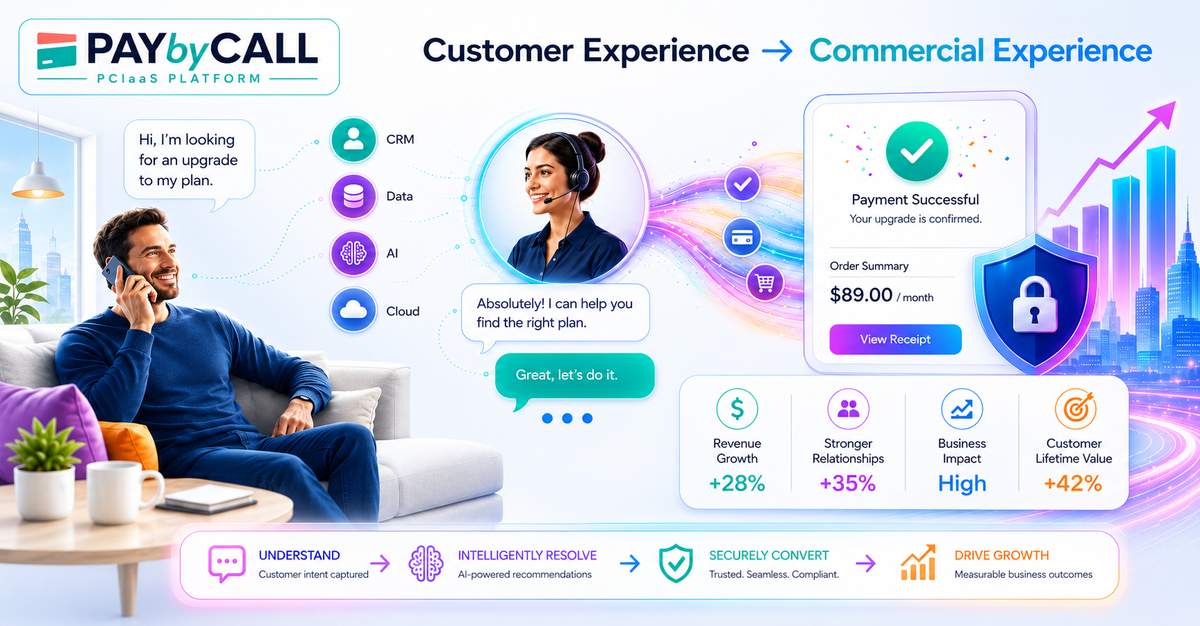
Customer Experience Is Evolving into Commercial Experience
For more than two decades, the Customer Experience industry has been built around one central ambition: helping organisations communicate better with their customers.
First came the modernisation of traditional telephony. Then came cloud contact centres, CRM integration, omnichannel engagement, analytics, automation, workforce optimisation and, more recently, artificial intelligence applied to customer service.
Each wave of technology promised to make customer interactions faster, smarter, more measurable and more personalised.
And in many ways, it has succeeded.
Today, a customer can call a company and be recognised almost instantly. The agent can view their history, understand previous interactions, receive AI-assisted recommendations and follow guided workflows in real time. A chatbot can answer simple questions. A voicebot can classify intent. A conversational AI solution can summarise the call, suggest the next best action and reduce the operational burden on the contact centre.
Yet despite all this progress, one of the most important moments in the customer journey remains surprisingly disconnected from the rest of the experience.
The payment.
Just when the customer has decided to buy, renew, donate, book, settle a debt, pay a bill, confirm a transaction or contract a service, many organisations still force them to leave the conversation.
After a natural interaction has built trust, resolved doubts and confirmed commercial intent, the customer is suddenly given an instruction that breaks the continuity:
“We will send you an SMS.”
“Please open this payment link.”
“Check your email.”
“Go to this web page.”
“Complete the payment outside the call.”
This is not a minor operational detail. It is a structural contradiction inside modern Customer Experience.
Companies are investing in artificial intelligence, cloud contact centres and conversational channels to make interactions more natural, but at the decisive moment — the moment of payment — many still force the customer out of the conversation.
The more advanced conversational AI becomes, the more visible this contradiction will be.
The more natural, contextual and intelligent the conversation becomes, the more absurd it will feel to interrupt it exactly when the customer is ready to complete the transaction.
That is why we believe Customer Experience is entering a new phase.
Customer Experience is evolving into Commercial Experience.
The Historical Limitation of Customer Experience
For many years, Customer Experience was understood primarily as a service discipline.
The objective was to resolve issues, reduce waiting times, improve satisfaction, increase first-contact resolution and lower operational costs.
All those goals remain important. But they no longer fully describe the reality of enterprise conversations.
A significant proportion of high-value customer interactions are not only about providing information. They are about completing an outcome.
A customer does not call an airline only to ask about a flight. Very often, they call to modify a booking, purchase additional services or pay a fare difference.
A customer does not call a utility only to understand an invoice. They may call to pay it, settle arrears or agree a payment plan.
A citizen does not contact a public administration only to receive information. They may need to pay a tax, a fine, a fee or a municipal service.
A donor does not call an NGO only to ask about a campaign. They may want to make a donation during that same interaction.
A hotel guest does not call only to check availability. They may want to confirm a reservation and leave a deposit.
In all these cases, the conversation has a commercial destination.
The value of the interaction is not completed when the customer receives an answer. It is completed when the operation is securely executed.
This changes the role of the contact centre.
The contact centre is no longer only a cost centre, nor merely a service channel. It is becoming a commercial execution environment.
And when the contact centre becomes a commercial execution environment, payment can no longer be treated as an isolated financial process. It becomes part of the Customer Experience architecture itself.
Why Channel Switching Damages Conversion
The payment link was a reasonable solution to a specific problem.
It allowed organisations to reduce PCI exposure by moving card data entry away from the agent environment and into a digital payment page. In many contexts, Pay by Link still makes sense.
But when it is used inside a live telephone conversation, the payment link introduces significant friction.
The customer has to leave the interaction at the exact moment when trust and payment intent have already been created. They must move from voice to SMS or email, from conversation to browser, from human or conversational assistance to a self-service checkout.
They may not receive the link immediately.
They may not open it.
They may not trust it.
They may be on the move.
They may have poor connectivity.
They may not be digitally confident.
They may decide to pay later and never return.
Every additional step creates another opportunity for abandonment.
And this is not only a user experience problem. It is an economic problem.
In a contact centre, conversion depends on timing. The customer’s intent is strongest while the conversation is alive, while the agent is present, while doubts have just been resolved and while the emotional context of the interaction is still active.
Breaking the channel interrupts that momentum.
The company has already paid for the call, the agent time, the CRM, the cloud infrastructure, the AI tools and all the systems required to reach that point. But the final transaction is still exposed to abandonment because payment has been separated from the conversation.
This is one of the great hidden inefficiencies of many modern Customer Experience environments: they optimise everything that happens before payment, but they do not control the payment moment itself.
Payment as the Final Mile of Customer Experience
The next evolution of Customer Experience requires organisations to think about payment differently.
Payment is not only a financial transaction. In conversational journeys, payment is the final mile of Customer Experience.
It is the moment when trust becomes commitment.
It is the point where intent becomes execution.
It is the operational bridge between service and revenue.
This is especially relevant in the voice channel.
Despite the growth of digital channels, voice remains one of the most powerful channels for complex, sensitive or high-value interactions. Customers still rely on voice when they need explanation, reassurance, guidance or human confirmation.
This happens in travel, insurance, utilities, financial services, healthcare, public administration, collections, donations, hotel reservations and many other sectors.
Voice is not disappearing. It is evolving.
And as voice becomes connected to AI, automation, real-time data and conversational agents, it will become increasingly important to secure the commercial outcome of that conversation.
An AI-enabled contact centre that can understand customer intent, recommend actions and guide the process, but cannot complete a secure payment inside the same conversation, will remain incomplete.
It will be conversational, but not transactional.
It will be intelligent, but not fully executable.
That is precisely the gap Pay by Call was created to address.
The Role of Pay by Call: PCIaaS for Conversational Commercial Execution
Pay by Call provides a PCIaaS platform designed to integrate secure phone payments into the customer journey, instead of adding payment as an external process at the end of the interaction.
The principle is simple: the customer should not have to adapt to the payment infrastructure. The payment infrastructure should adapt to the customer journey.
That is why Pay by Call does not require organisations to change their acquiring bank, PSP, payment gateway, CRM, PBX, CCaaS platform or contact centre architecture. The platform is designed to operate as a secure conversational payment layer on top of the systems the enterprise already uses.
This distinction matters.
Many enterprise payment projects become unnecessarily complex because they require organisations to replace systems that already work. Large companies do not want to rebuild their entire payment architecture to improve one specific channel. They need new capabilities that integrate with their existing environment, preserve operational continuity and reduce compliance risk without introducing additional friction.
Pay by Call follows that logic.
The company keeps its bank.
It keeps its PSP.
It keeps its contact centre.
It keeps its CRM.
It keeps its agent environment.
It keeps its operational workflows.
What changes is the way payment is introduced and completed inside the conversation.
In an agent-assisted model, the agent can remain in the interaction while the customer enters card details securely through DTMF masking. The agent does not see or hear the card data. Sensitive information does not enter the contact centre environment. The customer does not need to leave the call. The transaction can be completed while the conversation remains active.
This philosophy is very different from pushing the customer out of the channel.
Pay by Call treats payment not as a separate digital checkout, but as a secure stage inside the conversational experience.
From PCI Compliance to Commercial Performance
The first generation of secure telephone payment solutions was built mainly around PCI compliance.
The objective was to reduce the merchant’s PCI scope, prevent agents from accessing card data and protect the organisation against obvious security and compliance risks.
That was necessary, and it remains necessary.
But it is no longer enough.
The new question is not only whether a telephone payment can be PCI compliant.
The new question is whether the payment journey can be secure, integrated, authenticated, conversational and commercially effective.
This is where the market is changing.
Enterprises are no longer evaluating payment technology only as a risk reduction tool. They are increasingly evaluating it as part of their strategy for conversion, customer trust, operational efficiency and AI-readiness.
A payment that is PCI compliant but causes abandonment is not enough.
A payment that is secure but disconnected from the conversation is not enough.
A payment that protects card data but destroys commercial momentum is not enough.
The new generation of conversational payment infrastructure must combine compliance and conversion.
This is one of the reasons Pay by Call occupies a differentiated position.
It was not conceived only as a PCI tool. It was conceived around the customer journey.
That is why we describe it as PCIaaS for Commercial Experience.
Why PBC 3DS Is Strategically Important
There is another dimension that makes this transformation even more relevant: authentication.
With PSD2 and Strong Customer Authentication, digital card payments have evolved toward stronger authentication models, usually through 3D Secure.
Telephone payments, however, have traditionally remained within the MOTO category, outside the standard Strong Customer Authentication flows.
This has created a structural problem.
On one hand, telephone payments are often used for high-value, complex or sensitive transactions. On the other hand, they have historically lacked the same authentication mechanisms available in digital channels.
The market’s usual solution has been predictable: take the customer out of the call and move them into a digital environment where 3D Secure can be completed.
But this solution reinforces the same problem: channel switching.
The customer starts in voice, develops trust in voice, confirms intent in voice and then, at the decisive moment, has to authenticate somewhere else.
From a regulatory or fraud-prevention perspective, this may solve part of the problem. From a Customer Experience and conversion perspective, it creates another.
This is where PBC 3DS becomes strategically important.
PBC 3DS is Pay by Call’s patent-pending architecture designed to bring Strong Customer Authentication into the voice payment journey without forcing the customer to abandon the conversation.
The relevance of this should not be underestimated.
If secure authentication can be integrated into the voice journey, the industry no longer has to choose between security and conversational continuity. It becomes possible to maintain the natural flow of the interaction while adding a stronger layer of transactional authentication.
This is not simply an additional feature.
It changes the role of voice inside authenticated commerce.
It means that the telephone channel, historically treated as an exception to digital authentication, can evolve into a secure and authenticated commercial channel in its own right.
The Patent-Pending Layer for Secure Agentic Voice Commerce
The patent-pending nature of PBC 3DS is especially relevant because the market is moving toward a new category: Secure Agentic Voice Commerce.
Today, many companies still think about AI in the contact centre as a productivity tool.
AI can summarise calls, assist agents, classify intent, generate responses, automate simple tasks or recommend actions.
But that is only the first stage.
The next stage will be execution.
AI agents will not only answer questions. They will help customers complete processes. They will modify bookings, manage renewals, negotiate payment plans, complete purchases, recover failed transactions, update accounts and coordinate complex commercial workflows.
But autonomous or semi-autonomous commercial execution cannot scale without trust.
Every Agentic Commerce journey inevitably reaches the same critical questions:
Who is the customer?
What exactly are they authorising?
Has their intent been verified?
Can the transaction be authenticated?
Can the organisation prove what happened?
Can the payment be completed securely?
Without solid answers to these questions, AI can recommend, but it cannot execute safely.
That is why secure conversational payment infrastructure will become more important as AI becomes more capable.
The more AI participates in commercial journeys, the more enterprises will need mechanisms for authentication, authorisation, auditability and payment execution inside the conversation.
PBC 3DS is part of that future.
It is not only about improving today’s telephone payments. It is about preparing the voice channel for a scenario in which customers, human agents and AI agents interact in real time to complete commercial outcomes.
That is what we mean by Secure Agentic Voice Commerce.
The Architectural Implication for Large Enterprises
For large organisations, this shift has an important architectural consequence.
Payments can no longer be treated only as a financial backend. They must be available as a secure capability inside the customer engagement layer.
In practical terms, this means that the contact centre, CRM, AI orchestration layer and payment infrastructure need to work together.
The payment capability must be available when the conversation requires it. It must comply with PCI DSS. It must integrate with existing PSPs and acquiring banks. It must support agent-assisted journeys, automated IVR journeys, outbound recovery campaigns and future AI-driven journeys. It must maintain security without requiring enterprises to replace systems they have already deployed.
That is why the PCIaaS model is especially relevant.
Enterprises do not need another isolated payment product. They need a secure payment execution layer that can be embedded into different conversational journeys.
A utility may need bill payment recovery and arrears settlement.
An airline may need agent-assisted payments for bookings, changes or ancillary services.
A hotel may need deposits, guarantees or reservation payments.
A public administration may need accessible telephone payments for citizens.
An NGO may need trusted voice donation processing.
A BPO may need to offer PCI-compliant payment capability to multiple clients without redesigning each environment from scratch.
The underlying need is the same: complete the commercial outcome securely inside the conversation.
The operational model may vary, but the strategic requirement is identical.
Why This Shift Matters Now
For years, the separation between Customer Experience and payment was tolerated because contact centres were mainly operated by human agents and because the payment link seemed like an acceptable compromise.
But two factors are changing quickly.
The first is the rise in customer expectations. Customers expect journeys to be immediate, contextual and continuous. They do not understand why a company can identify them, advise them and guide them through an entire decision, but cannot complete the payment in the same interaction.
The second is the pressure introduced by AI. As AI makes conversations more natural and efficient, every discontinuity in the process becomes more visible. If an AI assistant can understand the customer’s intent, but the company still has to send a payment link, the journey remains unfinished.
That is why the future of Customer Experience will not be defined only by smarter conversations.
It will be defined by trusted execution.
The winning organisations will be those capable of connecting conversation, intent, authentication and payment into a single secure journey.
Customer Experience Is Evolving into Commercial Experience
Customer Experience was born to improve how companies interact with their customers.
Commercial Experience is about improving how companies complete outcomes with their customers.
The difference is fundamental.
A conversation that does not complete the expected outcome remains an incomplete conversation.
A payment that breaks the conversation introduces friction.
A security model that forces the customer to switch channels weakens trust.
An AI strategy that cannot execute authenticated transactions will remain limited.
The next generation of CX will require a new infrastructure layer: secure conversational payment execution.
That is the role Pay by Call aims to play.
Pay by Call enables organisations to transform the voice channel into a secure commercial channel. Its PCIaaS platform allows companies to complete payments without changing their bank, PSP, CRM or contact centre infrastructure. Its assisted and automated models preserve conversational continuity. And its patent-pending PBC 3DS architecture points toward a future in which Strong Customer Authentication can become part of the voice journey itself.
This is the bridge between today’s secure telephone payments and tomorrow’s Secure Agentic Voice Commerce.
The future of Customer Experience will not be defined only by how intelligently companies speak with their customers.
It will be defined by what those conversations are able to complete securely.
And in that future, payment will no longer be the moment when the conversation breaks.
It will be the moment when the experience becomes real.
If your organisation still sends customers out of the call to complete payment, Pay by Call can help you turn the voice channel into a secure commercial execution layer.