Pay by Link has grown because it is simple, but it does not always convert
Pay by Link has become one of the most widely used solutions for remote payment collection. Its promise is simple: generate a payment link, send it by SMS, email or WhatsApp, and let the customer complete the transaction autonomously on a payment page. For many businesses, especially in simple digital environments, this solution has provided a fast way to accept payments without developing a complex e-commerce platform or directly assuming the full technical burden of a checkout process.
The simplicity of the link is also its greatest weakness
However, that same simplicity is also its main limitation. Pay by Link works reasonably well when the customer is digitally autonomous, when the amount requires no explanation, when there is no urgency, when the payer fully trusts the link received, and when the transaction can be completed without assistance. But in a contact center, in a debt collection process, in a customer service call, in a public administration, in a utility, in an insurance company, in a hotel booking, or in a healthcare payment, the reality is often very different.
In the contact center, payment begins with a conversation
In these scenarios, payment does not originate from an autonomous digital experience. It begins with a conversation. An agent has managed to speak with the customer, resolve doubts, explain the amount, handle objections, negotiate conditions, and create a moment of high payment intent. At that precise moment, sending the customer a link may seem convenient from an operational point of view, but commercially it can be a critical mistake: the call is broken, the channel changes, the assisted experience becomes a web self-service process, and the customer is left alone in a flow that can be abandoned at any point.
The problem is not sending the link: the problem is getting the customer to pay
The problem, therefore, is not sending the link. The problem is whether the customer opens it, trusts it, completes the form, passes authentication, and actually pays.
Out of every 100 links sent, only a fraction become real payments
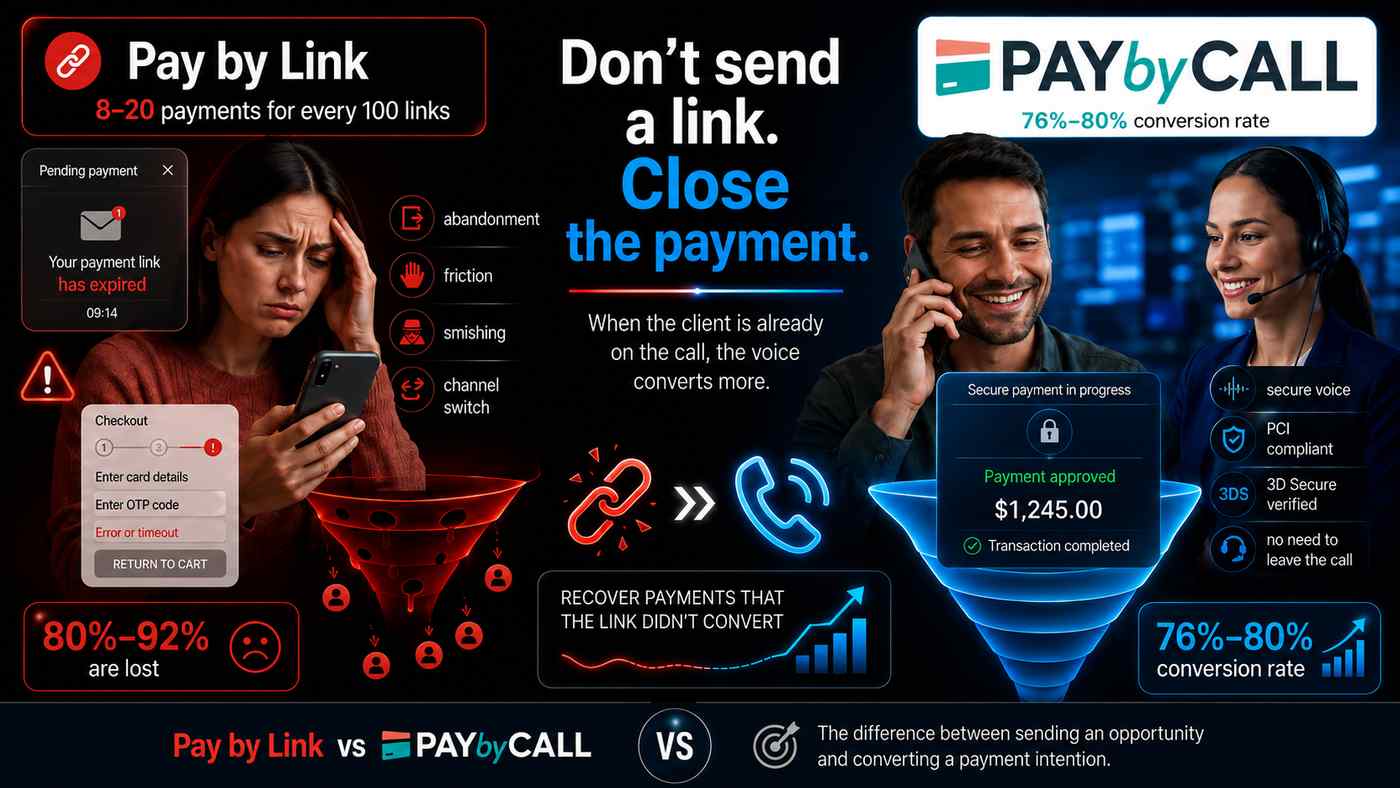
According to the funnel analysis included in the Pay by Call SL study, when delivery rates, reading rates, click-through rates, mobile abandonment, checkout friction and SCA/3D Secure authentication are combined, a Pay by Link sent by SMS may end up converting only between 8 and 20 payments per 100 links sent under normal conditions. It is important to stress that this figure does not come from a single isolated study, but from a consolidated estimate built from different market benchmarks, including MessageFlow, Infobip, Ravelin, Baymard Institute and Signifyd. The study itself places this conclusion within the analysis of the typical conversion funnel of a Pay by Link sent by SMS.
The key metric is not the link sent, but the payment completed
This difference between “link sent” and “payment completed” is essential for any contact center manager. Sending 100 links does not mean having 100 real payment opportunities. It may mean closing only a small fraction of them. And that loss is not always visible because it is diluted among apparently positive operational metrics: SMS sent, links generated, campaigns launched, or communications delivered. But the metric that matters is not how many links are sent, but how many payments are completed.
PaybyCall changes the logic of assisted remote payment collection
This is where Pay by Call SL’s model radically changes the logic of assisted remote payment collection. The PaybyCall platform is not designed to replace Pay by Link in every scenario. Pay by Link will remain useful for digital customers, simple amounts and low-risk transactions. The difference is that PaybyCall solves precisely the cases where the link fails: customers who need assistance, urgent payments, amounts that require explanation, users with low digital skills, debt collection processes, MOTO payments, transactions requiring strong authentication, and calls where there is already clear payment intent.
Pay by Link sends a payment opportunity; Pay by Call converts payment intent
The thesis is simple: Pay by Link sends a payment opportunity; Pay by Call converts payment intent inside the call.
PBC LAA + PBC 3DS: the customer pays without leaving the conversation
With PBC LAA + PBC 3DS, the agent remains on the line and assists the customer throughout the entire process, but never accesses sensitive card data. The customer enters the card details using the telephone keypad, and the system applies DTMF masking, so the agent neither sees nor hears the card number, and the call recording is protected against card data exposure. The major difference compared with Pay by Link is that the customer is not pushed out of the conversation. The customer remains assisted, maintains trust, resolves doubts in real time, and completes the payment in the same context in which the decision to pay was made.
PBC TFA + PBC 3DS: productivity for high-volume BPOs and contact centers
With PBC TFA + PBC 3DS, the agent transfers the customer to a secure IVR to complete the payment. This model is especially useful for BPOs and high-volume contact centers, where average handling time is critical and the agent cannot remain on the line throughout the entire payment process. The customer completes the payment within a secure environment, while the agent is released to handle another call. The company gains operational productivity, reduces PCI exposure and prevents the agent from participating in the sensitive data flow.
PBC 3DS brings strong authentication to the voice channel
The addition of PBC 3DS introduces an even more relevant differentiating element: the ability to bring 3D Secure authentication to the voice channel, without redirecting the user to a website and without breaking the call. The study describes PBC 3DS as a technology protected by national, international and European patent applications, designed to execute multifactor authentication protocols over real-time voice channels. This addresses one of the historical limitations of telephone payments: the difficulty of applying PSD2/SCA/3D Secure strong authentication within the voice flow.
Traditional telephone payments had a weakness: PBC 3DS solves it
This capability is especially relevant because many traditional telephone payments fall under MOTO environments, where historically there is no standard web session in which to apply 3D Secure. The practical consequence is that the merchant may assume higher fraud risk or be forced to push the customer out of the call through a link to complete web authentication. PBC 3DS breaks that logic: it keeps the experience in the voice channel and brings secure telephone payment closer to the authentication and protection level of authenticated e-commerce.
Conversion: the argument every contact center manager should look at closely
Conversion is the argument that every contact center manager should examine most carefully. The study compares the estimate of 8–20 completed payments per 100 SMS messages sent via Pay by Link with Pay by Call’s operational data, which historically records a 76% successful authorization rate on initiated transactions, with further potential improvement through conversational AI. These are not exactly identical metrics — one measures the full funnel from SMS delivery, while the other measures authorizations on initiated operations — but the comparison reveals something very important: when the customer is already in a call and agrees to start the payment, keeping them in the assisted channel can multiply the probability of closing the payment compared with redirecting them to an asynchronous digital process.
The real cost of a failed Pay by Link is not the SMS: it is the lost call
The economic consequence is clear. The real cost of a failed Pay by Link is not the cost of the SMS. It is the value of the wasted call, the agent’s time, the unrecovered debt, the unpaid invoice, the unclosed booking, the outstanding bill, or the customer who cools down after having shown payment intent. In a contact center, the most valuable moment is when the customer is present, identified, assisted and willing to pay. If, at that moment, the customer is sent outside the call, the company assumes the risk of losing a transaction that was already almost closed.
Pay by Call also recovers payments that Pay by Link fails to close
In addition, Pay by Call adds a second strategic dimension: it can not only convert better than Pay by Link in assisted scenarios, but can also operate as a recovery layer for failed Pay by Link payments. Every day, many companies generate links that are not opened, are abandoned, expire or remain incomplete. Traditionally, those payments are retried with new messages, reminders or digital campaigns. But if the customer did not open the link, did not trust the message, had authentication problems or needed help, insisting on the same channel may not solve the problem.
When the link fails, a secure call can rescue the transaction
In these cases, a secure PCI telephone call can recover the transaction. Pay by Call enables a call flow to rescue payments that the link failed to close. The agent can explain the reason for the charge, resolve objections, confirm the amount and guide the customer toward a secure payment within the voice channel. This combination makes Pay by Call a complementary, not substitutive, component of Pay by Link. The link can be the first attempt for digitally autonomous customers; Pay by Call can be the closing channel for assisted payments and the recovery channel for links that were not opened, abandoned or expired.
Security: the link can be impersonated; the secure call cannot
Security also favors the managed voice channel. The growth of smishing and link-based fraud has eroded users’ trust in SMS messages containing payment links. Even when the link is legitimate, many customers hesitate before clicking, especially if the message contains an opaque URL, if the amount is high, or if the context creates a sense of urgency. The study notes that payment links have structural vulnerabilities to impersonation: URLs that are difficult to verify, messages that imitate legitimate communications, the use of urgency, and the absence of a previously authenticated channel between merchant and customer.
In Pay by Call, there is no link to impersonate
In Pay by Call, that vector disappears. There is no link to impersonate. There is no fraudulent SMS to confuse with a legitimate one. There is no fake page to which the user can be redirected. The payment takes place inside a controlled call, with DTMF masking, without exposing card data to the agent, and within a PCI-DSS certified environment. For sectors where trust is critical — public administration, utilities, insurance, healthcare, debt collection or travel — this difference can be decisive.
PCI-DSS 4.0.1 increases pressure on web-based models
The evolution of PCI-DSS 4.0.1 further reinforces this interpretation. Pay by Link with pure redirection to a PSP-hosted payment page may keep PCI scope reduced in certain cases, but when iframes, JavaScript or elements of the merchant’s website are involved, the compliance burden can increase significantly. The study notes that certain models may move from SAQ A to SAQ A-EP, increasing the number of controls and the complexity of compliance. By contrast, the voice channel with DTMF masking and a PCIaaS model can reduce or remove from the merchant’s scope the exposure of card data in the contact center, including agents, internal systems and recordings.
Less PCI scope means less risk, less audit burden and less operational complexity
For companies, this is not a minor technical issue. Every expansion of PCI scope means more controls, more audit work, more operational burden and more risk. A contact center that captures, hears, stores or records card data enters an exposure zone that can be costly and complex. Pay by Call’s PCIaaS model allows that critical layer to be outsourced to a specialized, certified platform prepared to operate secure telephone payments at scale.
Where Pay by Call has the greatest advantage over Pay by Link
The sectors where this difference is most evident are precisely those where payment has a human, urgent or assisted component. In debt collection, the agent does not merely inform: the agent negotiates, adapts conditions and turns a promise into a payment. In utilities, many transactions are urgent: avoiding a disconnection, reconnecting a service or regularizing a debt. In public administration, secure telephone payment improves accessibility for citizens who cannot always complete digital processes. In insurance, trust and verification are decisive. In travel and hospitality, a call can close high-value bookings that a web checkout may lose. In healthcare, many patients need help, clarity and support before completing the payment.
The verticals where secure voice can make the difference
The study specifically identifies debt, utilities, healthcare, retail MOTO/contact center inbound, travel, insurance, public administration, subscriptions and donations as verticals where PBC LAA/TFA + PBC 3DS can offer a structural advantage over Pay by Link. The common reason across all of them is that payment does not depend merely on having a URL, but on converting an intent into a secure, authenticated and completed transaction at the right moment.
Pay by Call does not compete with PSPs: it amplifies them
It is important to emphasize another strategic point: Pay by Call SL does not compete with PSPs. The PaybyCall platform does not aim to replace the virtual POS, the acquiring bank, Redsys, Comercia Global Payments, Worldline, Stripe or other payment providers. Its function is to act as a technological layer of security and conversion between the contact center, the BPO, the switchboard or the IVR and the customer’s existing payment ecosystem. The company keeps its PSP, its bank, its payment architecture and its financial processes; Pay by Call adds the secure voice channel, PCI compliance, DTMF masking, 3DS authentication in voice, and the ability to recover payments that the link fails to close.
It is not about eliminating Pay by Link, but using it where it truly works
This complementarity is key to understanding the future of remote payment collection. It is not about declaring that Pay by Link does not work. It does work, but not for everything. It works for digitally autonomous customers, simple transactions and payments that do not require assistance. But when there is an ongoing call, urgency, negotiation, a vulnerable customer, a sensitive amount or a real closing opportunity, the secure voice channel can be far more effective.
The key question: how much money is being lost through links that do not convert?
That is why the question contact center managers should now ask is no longer whether they have Pay by Link or not. The right question is how much money they are losing every month through links that their customers do not open, abandon or let expire. And, above all, how many of those payments could be recovered if the company had a secure PCI telephone call available to close the transaction at the exact moment when the customer still has payment intent.
The future of remote payment collection will be hybrid, but voice will remain decisive
The future of remote payment collection will be hybrid. Some payments will be resolved through links, some will be completed on the web, some will be automated through wallets, and some will be initiated by AI assistants. But in every scenario where trust, urgency, assistance and conversion are critical, voice will continue to have a distinctive value. The difference is that voice can no longer be an insecure channel, without strong authentication and with data exposure. It must be secure, certified, integrated with the PSP and ready to comply with PCI-DSS and 3D Secure.
PaybyCall turns the contact center into a secure, high-conversion payment channel
That is Pay by Call SL’s proposal with PaybyCall: to transform the contact center into a secure, assisted and high-conversion payment channel.
Conclusion: Pay by Link sends the opportunity; Pay by Call closes the payment
Pay by Link sends a payment opportunity. Pay by Call converts payment intent. And when the link fails, Pay by Call can rescue the transaction.