
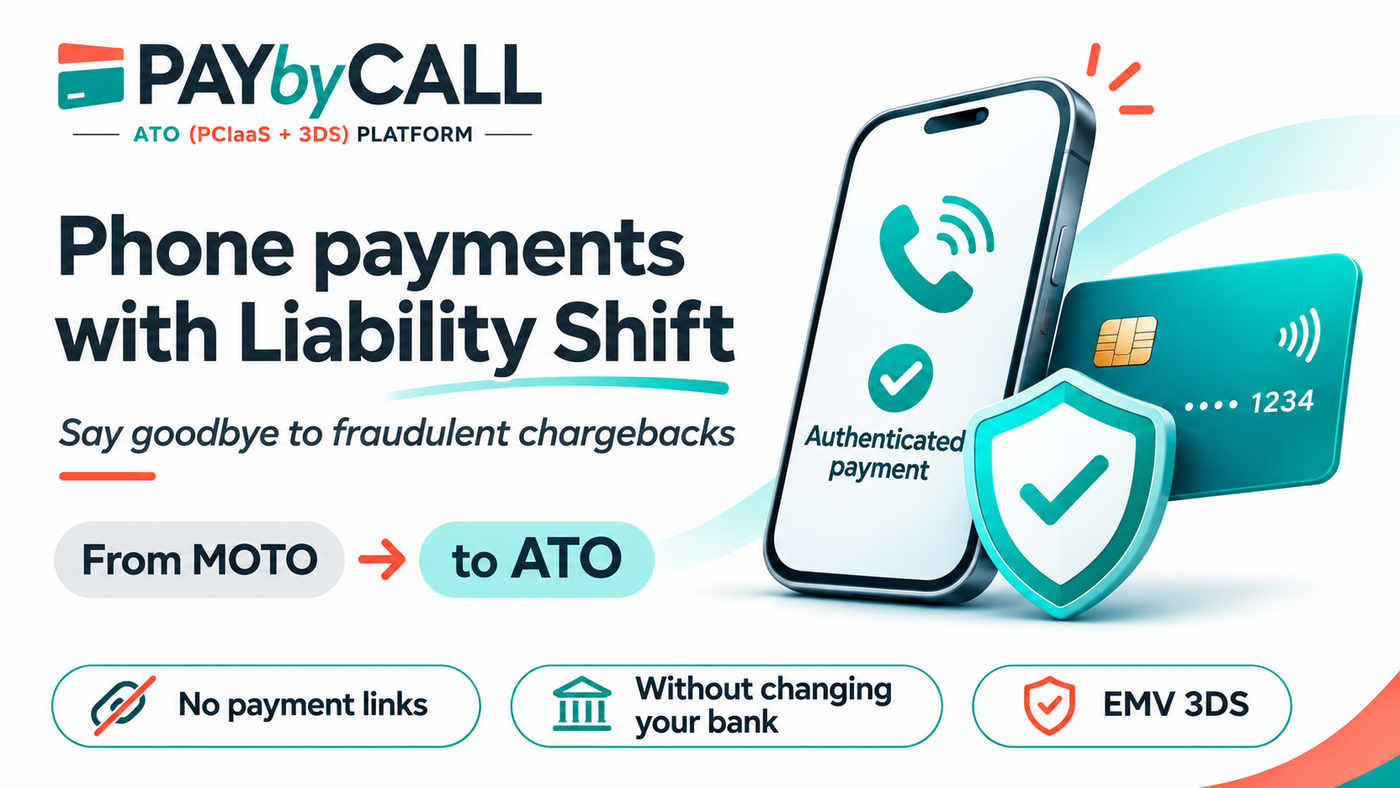
Pay by Call brings EMV 3-D Secure authentication to telephone payments, enabling merchants to benefit from liability shift without sending payment links or changing their existing bank or contact center infrastructure.
Card payments over the phone remain essential for thousands of businesses worldwide. Airlines, hotels, insurance companies, travel agencies, utilities and contact centers rely on this channel every day to process reservations, purchases, renewals and customer payments.
However, telephone payments have traditionally presented a significant challenge: the risk of cardholders subsequently disputing transactions and merchants being held financially responsible for fraud-related chargebacks.
Even when a transaction has been authorized by the issuing bank, the merchant may still face a fraud dispute and potentially lose the transaction amount.
But what if businesses could change this situation without abandoning telephone payments?
The answer is yes. And it represents a major step forward for the telephone payments industry.
The traditional challenge of MOTO payments
Traditional telephone payments fall under the MOTO (Mail Order/Telephone Order) category.
Unlike many e-commerce transactions, MOTO payments have historically been processed without EMV 3-D Secure cardholder authentication.
This distinction matters.
A bank may authorize a transaction without necessarily having authenticated the person using the card.
If the legitimate cardholder subsequently disputes the transaction as unauthorized, the merchant may be exposed to a fraud-related chargeback, even though the payment was originally approved.
For businesses processing hundreds or thousands of telephone payments, particularly high-value transactions, this exposure can have a significant impact on profitability.
One common alternative has been to send customers a payment link so they can complete the transaction through a web checkout.
However, this approach may introduce friction, interrupt the telephone sales journey and negatively affect conversion rates.
Why should customers have to leave the telephone channel to benefit from bank authentication?
A new generation of authenticated telephone payments
Pay by Call has developed PBC 3DS (patent pending), a technology designed to bring EMV 3-D Secure authentication directly into the telephone payment experience.
This capability allows the card issuer to authenticate the cardholder as part of the telephone payment process, without requiring the merchant to send a payment link.
Authentication may be completed without additional cardholder interaction or, when required by the issuer, through verification using the bank’s own secure authentication channels.
In either case, the payment remains integrated into the telephone journey.
When authentication is successfully completed and the transaction meets the applicable card scheme requirements, it may qualify for liability shift.
What does liability shift mean for your business?
Liability shift means that responsibility for certain fraud-related chargebacks can move from the merchant to the card issuer.
In practical terms, merchants may no longer have to bear the financial loss associated with eligible fraudulent transactions that have been successfully authenticated and correctly processed.
This represents a significant difference compared with traditional unauthenticated telephone payments.
Importantly, liability shift does not cover every type of dispute. Claims involving goods not received, services not provided, incorrect amounts or other commercial disagreements remain subject to their own chargeback rules.
From MOTO to ATO: the future of telephone payments
At Pay by Call, we call this evolution ATO — Authenticated Telephone Order.
ATO combines secure telephone payment processing with EMV 3DS cardholder authentication, bringing three essential capabilities together.
1. PCI DSS security with PBC PCIaaS
Pay by Call’s PCIaaS platform protects sensitive payment card information, keeping it outside the reach of contact center agents and business systems.
This helps businesses reduce their PCI DSS scope and associated compliance complexity.
2. EMV 3DS cardholder authentication with PBC 3DS (patent pending)
The issuing bank can authenticate the cardholder during the telephone payment process, without requiring payment links or redirecting customers to an external checkout page.
3. Fraud chargeback protection through liability shift
Successfully authenticated and correctly processed transactions may benefit from liability shift under the applicable card scheme rules.
This can significantly reduce merchants’ financial exposure to eligible fraud-related disputes.
Our approach can be summarized in one simple formula: PBC PCIaaS + PBC 3DS = ATO
A new generation of secure, authenticated telephone payments.
No need to change your bank, PSP or contact center platform
One of the key advantages of Pay by Call is that businesses do not need to replace their existing payment or telephony infrastructure.
Our platform is designed to integrate with existing acquiring banks, payment service providers (PSPs) and contact center environments, subject to the compatibility of each integration.
This enables merchants to introduce PCI DSS security and EMV 3DS authentication without unnecessarily transforming their established sales and customer service processes.
Pay by Call supports multiple payment scenarios, including:
- Agent-assisted telephone payments.
- Fully automated telephone payments.
- Payments handled by conversational AI.
- Payments initiated through other channels and securely completed over the phone.
All without requiring payment links.
Furthermore, PBC 3DS is included at no additional cost for customers using Pay by Call’s PCIaaS platform.
Which industries stand to benefit the most?
Authenticated telephone payments are particularly valuable for businesses handling high-value transactions or facing meaningful financial exposure to fraud-related chargebacks.
Airlines and travel agencies
Flight bookings, holiday packages and other travel services frequently involve substantial transaction amounts.
Adding bank authentication to telephone sales can help protect these businesses against eligible fraud-related disputes without disrupting the booking experience.
Hotels and hospitality groups
Telephone reservations, advance payments and additional guest services can benefit from greater payment security and issuer authentication.
Hotels can maintain direct customer relationships while reducing their exposure to certain fraudulent chargebacks.
Insurance companies
Insurance providers frequently process policy purchases, renewals and other payments over the phone.
ATO enables them to combine secure card data handling with bank authentication while preserving the convenience of the telephone channel.
Utilities and service providers
Energy, water, telecommunications and other service companies can enhance their telephone payment processes with cardholder authentication without fundamentally changing the customer experience.
Contact centers and BPO providers
Contact center operators can expand their payment capabilities by offering enterprise clients both PCI DSS security and EMV 3DS authentication.
This creates additional value for businesses looking to reduce fraud exposure while maintaining operational efficiency.
Across these industries, reducing avoidable fraud losses can have a direct impact on profitability.
Building customer confidence through bank authentication
Fraud prevention is not only about protecting merchants financially.
Consumers are increasingly familiar with bank authentication when making online purchases.
Bringing these capabilities to telephone payments extends an established security experience to the voice channel.
When the issuing bank can authenticate a transaction without requiring additional customer action, the payment may proceed with minimal friction.
When additional verification is necessary, the cardholder can use the secure authentication method provided by their bank.
The objective is straightforward:
Greater payment security for customers and reduced fraud exposure for merchants, without compromising the convenience of telephone payments.
The next step in telephone payment security
For years, the telephone payments industry has focused primarily on PCI DSS compliance and protecting sensitive cardholder data.
These capabilities remain essential.
But protecting card data alone does not address every fraud-related challenge.
Businesses can now go further by combining secure telephone payment processing with bank authentication and access to liability shift protection.
With PBC 3DS (patent pending), Pay by Call is helping drive the evolution from traditional MOTO payments to Authenticated Telephone Orders (ATO).
For merchants, this creates an opportunity to reduce exposure to eligible fraudulent chargebacks.
For banks and PSPs, it opens new opportunities to deliver authentication capabilities to the telephone channel.
And for contact centers, it represents an evolution from secure card data collection towards a more complete, authenticated payment experience.
The future of telephone payments is not just secure. It is authenticated.
How much are fraudulent telephone payment chargebacks costing your business?
If your company accepts card payments over the phone, now may be the right time to assess how much of that financial exposure could be reduced through authenticated telephone payments.
Pay by Call can show you how to incorporate EMV 3DS authentication into your telephone payment processes and under which conditions your transactions may qualify for liability shift.
No payment links. No need to replace your existing bank or contact center platform. And PBC 3DS is included in our PCIaaS solution at no additional cost.
Contact our team to discover how to move from MOTO to ATO.
Disclaimer: Liability shift eligibility depends on successful authentication, correct transaction processing and the applicable card scheme rules. It does not eliminate all types of chargebacks or guarantee transaction approval.