
7 out of 10 shopping carts are abandoned before checkout is completed. How many of those sales could be recovered if customers had the option to pay through a secure, assisted and authenticated phone call?
For years, eCommerce businesses have focused on simplifying checkout: reducing form fields, introducing digital wallets, enabling one-click payments and offering new financing options.
Yet there is still a significant group of consumers for whom entering payment card details on a website is not the ideal experience.
Some customers are reluctant to share card details online. Others need to clarify something before completing their purchase. Some face accessibility barriers, while others simply prefer speaking to someone.
Why should every customer be forced to pay in exactly the same way?
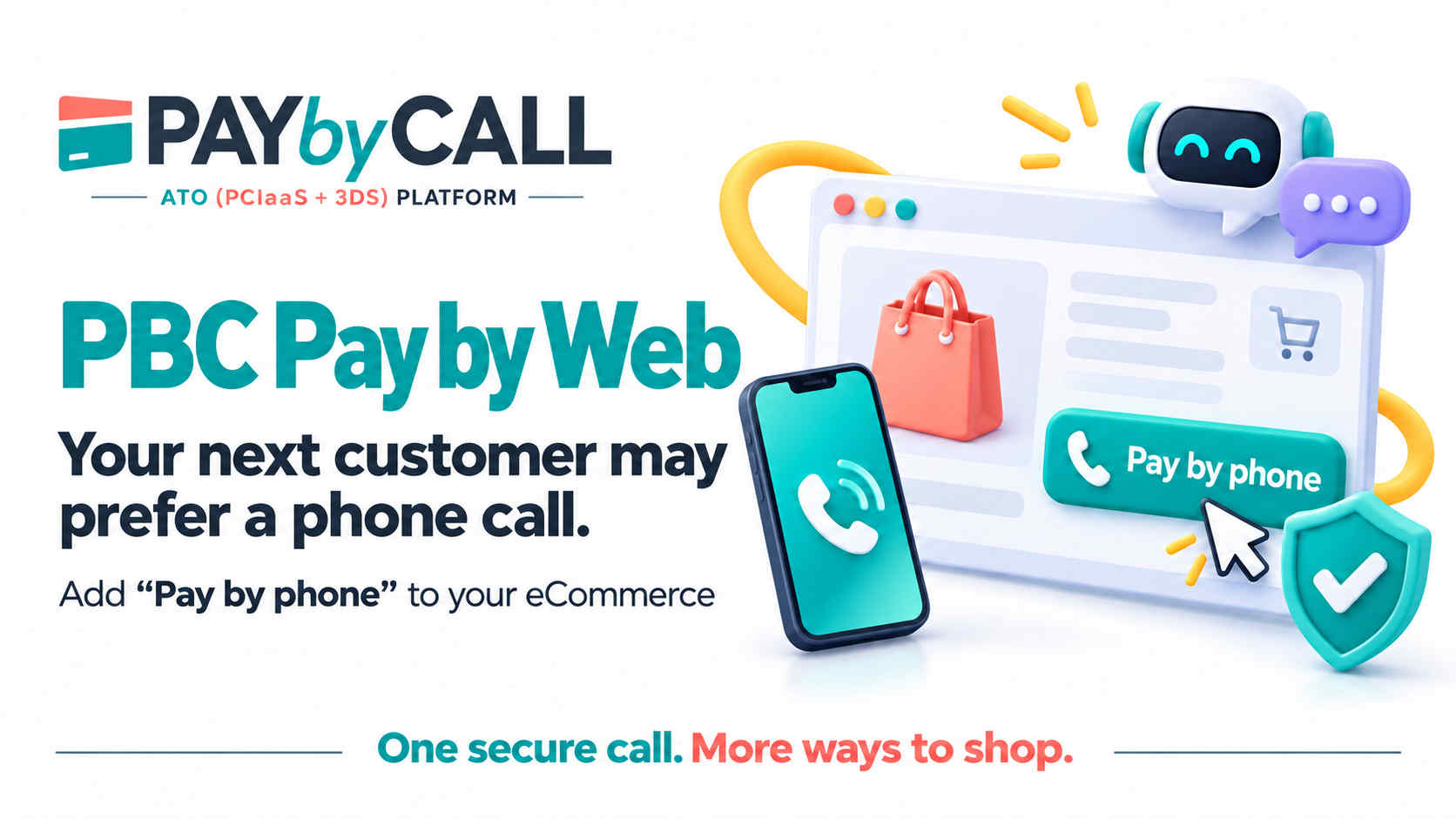
PBC Pay by Web, developed by Pay by Call, introduces an additional payment method directly into the eCommerce checkout: “Pay by Phone”.
A simple button connects the digital shopping experience with a PCI DSS-secure telephone call, handled either by a human agent or a conversational AI assistant.
When Strong Customer Authentication (SCA) is required, Pay by Call’s PBC 3DS technology (patent pending) enables EMV 3-D Secure authentication during the call, without sending a Pay by Link.
And all of this can be achieved without replacing the merchant’s existing Payment Service Provider (PSP) or acquiring bank.
PBC PCIaaS + PBC 3DS = ATO (Authenticated Telephone Order).
1. The eCommerce Challenge: A 70.22% Cart Abandonment Rate
According to Baymard Institute, the average documented online shopping cart abandonment rate is 70.22%, based on 50 independent studies.
In practical terms, approximately 70 out of every 100 shopping carts are abandoned before the purchase is completed.
Not every abandoned cart represents a lost sale. Many visitors are simply browsing, researching products or comparing prices.
However, among shoppers who abandon their purchases for reasons related to checkout, Baymard identifies several important barriers.
Its published research, excluding consumers who were merely browsing or not ready to buy, highlights the following reasons:
| Reason for abandonment | Percentage |
|---|---|
| Extra costs were too high | 40% |
| Delivery was too slow | 20% |
| Did not trust the website with card information | 19% |
| Required to create an account | 18% |
| Checkout process was too long or complicated | 17% |
| Website errors or crashes | 17% |
| Not enough payment methods | 9% |
Source: Baymard Institute, Cart Abandonment Rate Statistics. Percentages represent reported reasons among surveyed shoppers, not percentages of all shopping carts. Multiple reasons may apply.
Two figures are especially relevant to alternative payment experiences:
19% of respondents cited concerns about sharing payment card information, while 9% reported insufficient payment options.
A secure telephone payment alternative may help address these concerns for some customers.
It can also create an opportunity to resolve questions about delivery, product specifications, returns or the final price before the customer abandons the transaction.
This does not mean that all these abandoned purchases could be recovered through a phone call. Public evidence is not sufficient to establish a universal recovery rate for assisted telephone payments.
Nevertheless, the commercial opportunity deserves serious consideration.
What Would Recovering Just a Small Percentage of Abandoned Carts Mean?
Consider an eCommerce business with the following monthly figures:
- 100,000 shopping carts initiated.
- A 70.22% abandonment rate.
- An average order value of €120.
- A new telephone payment option capable of recovering a small proportion of purchases that would otherwise have been permanently abandoned.
The potential additional revenue would be:
| Abandoned carts recovered | Additional monthly sales |
|---|---|
| 0.5% | €42,132 |
| 1% | €84,264 |
| 2% | €168,528 |
| 3% | €252,792 |
Illustrative financial simulation, not actual Pay by Call performance data. Calculations assume that recovered carts become genuinely incremental completed purchases with an average value of €120, excluding refunds, cancellations and operating costs.
Even a modest improvement in conversion can represent a meaningful revenue opportunity.
The objective is not necessarily to replace existing payment methods.
It is to offer an additional way to complete a purchase for customers whose needs are not fully met by conventional checkout experiences.
2. Checkout Accessibility Is Now a Legal Requirement in the European Union
There is another reason to rethink how customers complete online purchases: digital accessibility.
The European Accessibility Act, established by Directive (EU) 2019/882, sets accessibility requirements for certain products and services, including eCommerce services.
Its principal requirements began applying on 28 June 2025, subject to the directive’s scope, exemptions and transitional provisions.
In Spain, these requirements were transposed through Law 11/2023 of 8 May.
The legislation includes accessibility requirements affecting essential eCommerce functions such as:
- User identification.
- Security.
- Authentication and interaction.
- Payment functionality.
- Information needed to complete a transaction.
In other words, providing an accessible product catalogue is not sufficient if customers encounter insurmountable accessibility barriers during checkout.
Who Could Benefit From an Assisted Telephone Payment Option?
Customers with visual impairments. A voice-based interaction may be preferable to complex online forms, provided that the telephone interface and payment process are appropriately accessible.
Older consumers. Some customers feel more comfortable speaking to a person than navigating multiple payment screens.
People with cognitive disabilities or limited digital experience. Conversational assistance can help explain each step and resolve uncertainties.
Customers making complex purchases. Travel bookings, insurance policies and high-value purchases often involve questions that are easier to address through direct interaction.
Accessibility should not mean forcing everyone to use a particular technology.
It should mean offering different ways to access and complete the same service.
Can “Pay by Phone” Support Accessibility Compliance?
Yes, as part of a broader multichannel accessibility strategy.
However, adding a telephone payment button does not automatically make an eCommerce website compliant with the European Accessibility Act.
The website, the button itself, the telephone interaction and any alternative payment flows must be designed and assessed appropriately.
The applicable legislation also contains exemptions for certain microenterprises providing services, transitional provisions and mechanisms addressing disproportionate burdens.
The key commercial conclusion remains clear:
Accessible payment alternatives can improve the customer experience, support digital inclusion and create additional conversion opportunities.
3. Why Has Traditional Telephone Payment Never Become a Standard eCommerce Checkout Option?
Telephone payments are not new.
For decades, airlines, hotels, insurers, transportation companies and service providers have accepted card payments over the phone.
These transactions are generally classified as MOTO: Mail Order / Telephone Order.
The problem with traditional telephone payment arrangements is that card data may be exposed to multiple systems and participants.
When customers verbally disclose their payment card number, expiry date and security code, sensitive information may pass through:
- The customer service agent.
- Telephony systems.
- Contact centre infrastructure.
- Agent desktop applications.
- Call recording systems.
- Internal business processes.
This creates security risks and may expand the merchant’s PCI DSS compliance obligations.
Even when card data is handled securely, another important issue remains: verifying that the person using the card is its legitimate holder.
PCI DSS Does Not Mean Cardholder Authentication
This distinction is essential.
PCI DSS protects payment card data through technical and organisational security requirements.
Strong Customer Authentication (SCA) concerns verifying the payer’s identity using the applicable authentication requirements.
EMV 3-D Secure provides a framework for authentication in card-not-present payment environments, involving card issuers and other participants in the payments ecosystem.
A payment system may protect card information in a PCI DSS-compliant environment without performing strong cardholder authentication.
These are different but complementary capabilities.
Protecting card data and authenticating the payer are not the same thing.
This distinction becomes particularly important when extending modern payment authentication technologies to the telephone channel.
4. PBC Pay by Web: Adding “Pay by Phone” Directly to the Checkout
PBC Pay by Web is Pay by Call’s solution for extending secure telephone payments beyond traditional contact centres and into digital commerce.
Unlike conventional telephone payment solutions, PBC Pay by Web begins directly on the merchant’s website.
Customers can continue shopping online while choosing to complete their payment through a secure telephone call.
How Does It Work?
Step 1. The customer selects “Pay by Phone”.
The payment option appears alongside the merchant’s existing checkout methods.
Step 2. The customer provides a telephone number.
Through an API integration, the eCommerce platform provides Pay by Call with the information needed to associate the payment interaction with the corresponding order and amount.
Step 3. Pay by Call initiates a secure telephone call.
The customer receives a call linked to their purchase.
Step 4. The call is handled by a conversational AI assistant or human agent.
The customer can confirm order details, ask questions and receive guidance throughout the payment process.
Step 5. Payment card details are captured securely.
The customer enters card information through the telephone keypad using DTMF masking technology.
Step 6. Authentication is performed when required.
Where supported by the relevant issuer and transaction flow, PBC 3DS enables EMV 3-D Secure authentication to be managed during the call.
Step 7. The merchant receives the payment result.
Pay by Call works with the merchant’s existing PSP and acquiring bank through the corresponding integrations, maintaining the appropriate authorisation and reconciliation processes.
The result is a shopping experience that starts online and finishes through a secure, assisted telephone interaction.
5. Two Customer Experiences: Conversational AI or Human Assistance
One of the distinctive capabilities of PBC Pay by Web is its flexibility.
Different customers and different types of purchases require different levels of assistance.
Conversational AI: Automated Payment Assistance
Modern conversational AI assistants can provide natural and context-aware customer interactions.
Within the telephone payment journey, they can:
- Confirm the products or services being purchased.
- Explain the amount to be charged.
- Answer frequently asked questions.
- Guide customers through the payment stages.
- Support the user during the transaction.
- Transfer the interaction to a human agent when necessary.
This makes it possible to design automated payment assistance services that operate 24/7 and can scale according to demand.
Importantly, the AI assistant does not need to hear, view or process sensitive payment card credentials.
Those details are captured through Pay by Call’s specialised secure payment infrastructure.
Human Agents: Personalised Assistance
Not every purchase should be handled entirely through automation.
Some customers prefer speaking with a human agent, particularly when the transaction involves complex decisions or substantial amounts of money.
Consider customers booking international travel, purchasing insurance or ordering high-value products.
They may need explanations about coverage, availability, delivery conditions or cancellation policies.
The human agent can provide assistance and guide the payment without accessing the customer’s card credentials.
A Hybrid Experience
Merchants can combine both approaches.
Conversational AI can handle routine transactions, while human agents manage interactions requiring more detailed advice.
Customers may also be offered the option of requesting personal assistance.
The important principle is that receiving assistance should never require customers to disclose their payment card information to the person or AI system helping them.
6. DTMF Masking and PCI DSS Level 1: Card Data Remains Protected
Pay by Call operates a PCI DSS Level 1 payment platform designed to protect card data captured during telephone transactions.
Its DTMF masking technology allows customers to enter card details using their telephone keypad.
The technology processes the keypad signals while preventing sensitive card information from being exposed to the customer service agent, conversational AI assistant or ordinary contact centre systems.
Sensitive data is handled within the appropriate secure payment infrastructure.
This approach can significantly reduce the merchant’s exposure to cardholder data and help reduce the PCI DSS scope of connected business systems, depending on the integration architecture and operational controls.
Key advantages include:
- Customers do not need to dictate their payment card credentials.
- Human agents cannot access the card details.
- Conversational AI systems do not need to process sensitive card information.
- Ordinary merchant systems do not need to receive the credentials.
- Call recording systems can remain outside the card data capture process.
From PCI Compliance Infrastructure to PCIaaS
Traditionally, securing telephone payments could require substantial investment in infrastructure, compliance controls and ongoing maintenance.
Pay by Call provides these capabilities through a specialised service model.
This is the value proposition of PCIaaS — PCI Compliance as a Service.
Businesses can transfer part of their PCI DSS infrastructure and compliance-related operational complexity to a specialised technology platform.
The opportunity is to replace certain capital-intensive requirements with a scalable operating expense model, while retaining the merchant’s own compliance responsibilities.
7. From MOTO to ATO: Authenticating Telephone Payments With PBC 3DS
Protecting card data is essential, but it is not enough to address every type of payment fraud.
Even when card credentials are handled securely, an unauthorised person may attempt to use them.
This is where Pay by Call’s second technology comes into play.
What Is PBC 3DS?
PBC 3DS is Pay by Call’s proprietary technology, currently patent pending, designed to integrate SCA/EMV 3-D Secure authentication into telephone payment transactions.
Its objective is to make strong authentication possible during the telephone interaction, without forcing customers to switch to a separate Pay by Link payment journey.
Where supported by the relevant issuer and authentication flow, the cardholder can complete the required authentication steps while remaining within the telephone payment experience.
What Is ATO?
Pay by Call has introduced the concept of ATO — Authenticated Telephone Order to distinguish authenticated telephone payments from traditional, unauthenticated MOTO transactions.
The technology can be expressed through a simple formula:
PBC PCIaaS + PBC 3DS = ATO
PBC PCIaaS protects the payment card data.
PBC 3DS enables the authentication process.
Together, they provide the technological foundation for secure and authenticated telephone payments.
ATO is a concept introduced by Pay by Call. It is not currently a universally established regulatory or card scheme transaction classification.
What About Fraud, Chargebacks and Liability Shift?
EMV 3-D Secure authentication can help reduce the risk of certain fraudulent card transactions and provide additional authentication evidence.
However, technical authentication and card scheme treatment must be distinguished.
The availability of liability shift depends on the applicable Visa, Mastercard or other card scheme rules, the transaction indicators, the authentication flow and the relevant transaction classification.
It should not be assumed that every authenticated telephone payment automatically receives the same liability treatment as an authenticated eCommerce transaction.
Pay by Call is engaging with participants in the payments ecosystem to clarify the applicable rules and promote the recognition of properly authenticated telephone payment flows.
The strategic opportunity is to bring modern cardholder authentication capabilities into the telephone channel.
8. Why Not Simply Send a Pay by Link?
Sending a payment link by SMS or email is a common approach when customers are speaking with a contact centre agent.
However, this introduces a different customer experience.
The customer must:
- Locate the message.
- Open the payment link.
- Navigate to a separate interface.
- Enter payment details.
- Complete any required authentication.
In other words, the customer leaves the assisted telephone payment journey and returns to another digital interface.
For many customers, this is perfectly acceptable.
But for customers who chose telephone assistance because they need guidance, have difficulty using digital interfaces or feel uncomfortable entering card information online, a Pay by Link may recreate the very barriers they were trying to avoid.
PBC Pay by Web offers a different approach.
The customer chooses to speak, receives assistance and completes the payment within the telephone interaction.
When SCA/EMV 3DS is required, PBC 3DS is designed to manage the authentication during the call, without requiring a separate payment link.
Pay by Link remains a useful solution in many circumstances.
The point is not to replace it universally, but to provide an additional alternative for consumers who prefer to complete their entire payment experience by phone.
9. Add a New Payment Method Without Changing Your PSP or Acquiring Bank
PBC Pay by Web is not designed to replace the merchant’s existing payment infrastructure.
Pay by Call is not a PSP and does not act as a substitute for the acquiring bank.
It provides a specialised technology layer for secure telephone payments and authentication.
Through the appropriate integrations, merchants can continue using their existing payment service providers and acquiring relationships.
This creates a significant commercial advantage.
Merchants can add “Pay by Phone” as an additional checkout option without undertaking a complete migration of their current payment infrastructure.
Instead of replacing card payments, digital wallets or other existing checkout methods, PBC Pay by Web expands the range of available payment experiences.
The integration can therefore focus on introducing an additional customer capability rather than redesigning the entire payment processing ecosystem.
10. Which eCommerce Sectors Could Benefit Most?
Although PBC Pay by Web can support different types of online businesses, certain industries may offer particularly attractive use cases.
Travel, Airlines and Hospitality
Complex travel itineraries, multiple passengers, additional services and higher-value bookings frequently generate questions before payment.
Telephone assistance enables customers to clarify important information while completing the transaction.
Insurance
Insurance purchases often involve policy coverage, exclusions, excesses and contractual conditions.
An assisted payment experience can maintain continuity between advice and purchase completion.
Private Healthcare
Healthcare services may involve personalised customer assistance and accessibility needs.
A secure telephone payment option can provide an additional way to complete purchases or service bookings.
Transportation and Mobility
Ticket purchases, bookings for several passengers and additional travel services can benefit from assisted checkout processes.
High-Value Retail
Electronics, furniture, jewellery and other high-value products frequently involve customers who want reassurance before making a purchase.
The ability to answer questions and complete payment in one interaction can support conversion.
Subscriptions and Service Renewals
For contracts, subscriptions and renewals, customers may need clarification before authorising a payment.
A guided telephone experience can help bridge the gap between understanding an offer and completing the transaction.
The common factor across these industries is not the customer’s age or digital literacy.
It is the presence of purchasing situations in which a conversation can help build confidence and support transaction completion.
11. How Should Merchants Measure the Value of “Pay by Phone”?
Introducing a new payment option should be supported by objective performance measurements.
For PBC Pay by Web, merchants should consider tracking:
Payment method adoption. The percentage of checkout visitors choosing “Pay by Phone”.
Successful call connection. The percentage of initiated calls that result in a completed customer interaction.
Payment conversion. The percentage of customers successfully completing payment after selecting the telephone option.
Incremental recovered sales. Purchases genuinely recovered through the new payment method, distinguishing incremental transactions from purchases that would otherwise have been completed using another payment method.
Interaction duration and cost. Average call duration, automated or human assistance costs and total cost per completed transaction.
Payment authorisation and authentication. PSP authorisation outcomes and EMV 3DS authentication results where applicable.
Accessibility and customer satisfaction. User feedback and usability outcomes across different customer needs.
A controlled pilot can compare an existing checkout experience with one that also includes PBC Pay by Web.
This provides a stronger basis for assessing the commercial impact than relying only on estimated conversion improvements.
12. The Future of eCommerce Will Also Be Conversational
Artificial intelligence is changing how businesses interact with customers.
Conversational assistants can answer questions, understand customer requirements, recommend products and guide purchasing decisions.
However, there is a fundamental difference between assisting a purchase and securely processing a payment.
An AI assistant does not need access to sensitive card credentials to help complete a transaction.
Likewise, conversational capability alone does not satisfy PCI DSS requirements or automatically provide strong customer authentication.
Conversational commerce requires specialised payment infrastructure.
Pay by Call proposes an architecture combining three complementary capabilities.
Conversation: Human or AI-powered interactions that guide the customer.
Protection: PCI DSS-secure card data capture, separated from the conversation.
Authentication: SCA/EMV 3-D Secure through PBC 3DS when required and supported.
Together, these capabilities support the development of Secure Agentic Voice Commerce.
In this model, intelligent assistants can facilitate commercial transactions while delegating sensitive payment processing and authentication to specialised infrastructure.
The aim is to enable conversational commerce without exposing financial credentials to general-purpose AI systems.
13. The Best Payment Method Is to Offer Them All. Because the Best One Is the One Your Customer Chooses.
For years, eCommerce innovation has focused on reducing clicks and eliminating human intervention.
But a completely automated experience is not always the right choice for every customer.
Some consumers want to pay in seconds.
Others prefer a digital wallet.
Some need instalment payments or financing.
And others would rather speak to someone, resolve a concern and complete their purchase with confidence.
PBC Pay by Web brings this additional option to eCommerce: payment through a secure telephone call, assisted by a human agent or conversational AI, with EMV 3-D Secure authentication when appropriate.
Without changing the PSP.
Without replacing the acquiring bank.
Without exposing card details to the agent or AI assistant.
Without requiring the customer to leave the call to open a payment link.
The technology connects the digital checkout with a secure, specialised telephone payment channel.
Your eCommerce business should not lose a sale simply because your customer would rather speak before paying.
Add “Pay by Phone” to Your eCommerce Checkout
Discover how PBC Pay by Web can expand your payment options, improve the customer experience and help reduce checkout barriers for customers who prefer assisted purchases.
PBC Pay by Web + PBC 3DS (patent pending)
Request a demo from Pay by Call.
The best payment method is to offer them all. Because the best one is the one your customer chooses.
Sources and Further Reading
- Baymard Institute — Cart Abandonment Rate Statistics. Online cart abandonment research and reported checkout barriers. https://baymard.com/lists/cart-abandonment-rate
- Baymard Institute — Checkout UX Guide. Research into checkout usability and conversion optimisation. https://baymard.com/blog/checkout-flow-ux-optimization
- European Union — Directive (EU) 2019/882. European Accessibility Act and accessibility requirements for certain products and services. https://eur-lex.europa.eu/eli/dir/2019/882/oj
- Spain — Law 11/2023 of 8 May. Spanish implementation of European accessibility requirements. https://www.boe.es/buscar/act.php?id=BOE-A-2023-11022
- European Banking Authority — Q&A 2018_4058. Interpretation of PSD2 strong customer authentication requirements in certain telephone and IVR payment scenarios. https://www.eba.europa.eu/single-rule-book-qa/qna/view/publicId/2018_4058
- PCI Security Standards Council — Industry Guidance on Accepting Telephone Payments Securely. Guidance on reducing risks in telephone payment environments. https://blog.pcisecuritystandards.org/industry-guidance-on-accepting-telephone-payments-securely
- Pay by Call — PCI DSS vs. SCA: From MOTO to Authenticated Telephone Payments. https://paybycall.com/en/pci-dss-cardholder-authentication-moto-ato-telephone-payments/
- Pay by Call — From MOTO to ATO: Authenticated Telephone Payments. https://paybycall.com/en/from-moto-to-ato-authenticated-telephone-payments/
- Pay by Call — MOTO Payments in Europe: Market Size, Security and Authentication. https://paybycall.com/en/moto-payments-europe-2025-market-security-authentication/