
As customer interactions increasingly take place through remote channels, organizations need payment solutions that are both secure and frictionless.
Two payment models are commonly used to process remote payments in customer service environments: Pay by Link and agent-assisted payments (Pay by Agent).
Both models allow organizations to accept payments remotely, but they are designed for very different interaction contexts.
Understanding the differences between these approaches is essential for companies that want to maximize payment conversion while maintaining the highest security standards.
Pay by Link: A Digital Payment Model
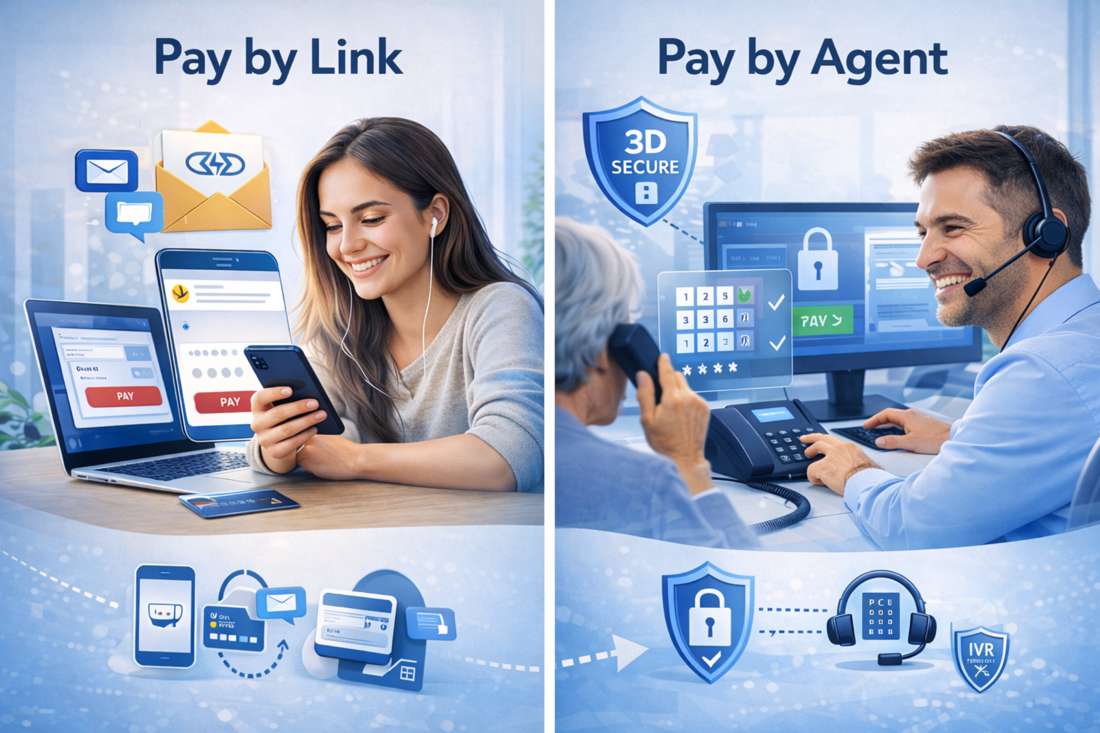
Pay by Link is a remote payment method where a customer receives a payment link and completes the transaction on their own device.
The link can be delivered through:
- SMS
- messaging platforms such as WhatsApp
- chat applications
Once the customer opens the link, they are redirected to a secure payment page where they can enter their card details and complete the payment.
In most implementations, the payment is authenticated through 3D Secure, the same security protocol widely used in ecommerce.
When Pay by Link Works Best
Pay by Link is particularly effective when the customer interaction is already happening in digital channels.
Typical use cases include:
- ecommerce support
- online bookings
- digital customer service interactions
- email-based payment requests
In these situations, Pay by Link provides a convenient and familiar payment experience.
However, when the payment originates in a telephone interaction, the experience can become less efficient.
The Friction Problem in Voice-Initiated Payments
When a payment starts during a phone call, Pay by Link requires the customer to switch channels.
The typical flow becomes:
Customer call
→ agent sends payment link
→ customer receives SMS or email
→ customer opens link
→ customer completes payment in browser
Each step introduces potential friction.
Customers may need to:
- search for the message
- switch applications
- confirm the legitimacy of the link
- complete the payment outside the call
As a result, the risk of payment abandonment increases.
For this reason, many organizations prefer a payment solution that allows the transaction to be completed within the phone call itself.
Pay by Agent: Payments Inside the Call
Pay by Agent refers to a payment model designed specifically for call center environments.
In this model, the payment is completed during the call without requiring the customer to switch channels.
The customer enters their card details directly through the telephone keypad using a secure IVR payment system.
This allows the payment to happen within the same interaction in which the transaction was initiated.
However, it is important to distinguish between secure agent-assisted payments and outdated telephone payment practices.
The Problem with Traditional Telephone Payments
In some organizations, customers are still asked to read their card details aloud to an agent.
The agent then manually enters the card number into a payment terminal or web interface.
This approach creates serious security and compliance risks:
- cardholder data becomes visible and audible to agents
- sensitive information may be captured in call recordings
- internal fraud risks increase
- the entire call center infrastructure falls within the scope of PCI-DSS compliance
For these reasons, modern payment security standards discourage the manual handling of card data by agents.
Secure Agent-Assisted Payments
Modern Pay by Agent solutions eliminate these risks by ensuring that the agent never has access to cardholder data.
In a secure architecture:
- the customer enters card details using the telephone keypad
- keypad tones are automatically masked
- the agent cannot hear or see the card data
- the information is processed directly within a PCI-DSS Level 1 certified environment
This allows organizations to process payments during calls while maintaining full compliance with payment security standards.
Pay by Call: Secure IVR Payments for Contact Centers
Pay by Call provides a specialized platform for secure telephone payments, enabling organizations to accept payments within voice interactions while maintaining the highest levels of security.
The platform supports multiple agent-assisted payment models tailored to contact center operations.
PBC TFA (Transfer From Agent)
In the Transfer From Agent model, the agent transfers the customer to a secure IVR payment environment.
The payment flow is fully isolated within the secure infrastructure.
Customer journey:
Agent interaction
→ call transferred to secure IVR
→ customer enters card details
→ payment processed
This model completely removes card data exposure from the agent environment.
PBC LAA (Live Agent Assisted)
In the Live Agent Assisted model, the agent remains on the call while the payment is completed.
The customer enters card details through the keypad while the system masks the tones.
The agent can continue guiding the customer through the process without ever hearing or seeing the card details.
This model provides a balance between:
- human assistance
- payment security
- high conversion rates
PBC 3DS: Bringing Strong Customer Authentication to Voice Payments
In addition to PCI-DSS compliance, Pay by Call has developed an authentication procedure called PBC 3DS, which enables 3D Secure authentication within telephone payment flows.
Through this system:
- The customer enters card details via secure IVR.
- The issuing bank initiates a 3D Secure authentication challenge.
- The customer authenticates the transaction through their banking app or verification code.
- The payment is validated while the customer remains on the call.
The PBC 3DS procedure, whose international patent has been filed by Pay by Call, extends ecommerce-level authentication to the voice channel.
Telephone Payments with Ecommerce-Level Security
By combining:
- secure IVR card entry
- PCI-DSS Level 1 infrastructure
- DTMF masking technology
- Strong Customer Authentication through 3D Secure
Pay by Call enables organizations to process telephone payments with the same level of security and authentication as ecommerce transactions.
This architecture protects cardholder data while allowing payments to be completed within the natural flow of a customer conversation.
Choosing the Right Payment Model
Both Pay by Link and Pay by Agent have valid use cases.
Pay by Link is ideal when:
- the interaction originates in digital channels
- the customer is already using web or mobile interfaces
- multiple payment methods are required
Pay by Agent is ideal when:
- the payment originates in a phone call
- the organization wants to close the transaction during the conversation
- customer assistance is required during the payment process
- maximizing payment conversion is a priority
Secure Voice Payments with Pay by Call
Pay by Call provides a payment infrastructure designed specifically for the voice channel.
Through secure IVR payments, agent-assisted models and integrated 3D Secure authentication, organizations can now accept payments by phone with the same security guarantees as digital commerce.
With technologies such as PBC TFA, PBC LAA and PBC 3DS, the voice channel can finally deliver payment experiences that are secure, compliant and optimized for conversion.
Frequently Asked Questions (FAQ)
What is the difference between Pay by Link and Pay by Agent?
Pay by Link allows customers to complete a payment through a web link sent via SMS, email or messaging platforms. The customer opens the link and finishes the transaction on a web payment page.
Pay by Agent, on the other hand, enables the payment to be completed directly during a phone call. The customer enters card details through a secure IVR system while staying connected with the agent.
When should companies use Pay by Link?
Pay by Link works best when the customer interaction already takes place in digital channels such as email, web chat or messaging apps. It is commonly used for ecommerce support, digital customer service interactions and payment requests sent through email or SMS.
Why can Pay by Link introduce friction during phone calls?
When a payment begins during a call, Pay by Link requires the customer to switch from the voice channel to a web browser. The customer must locate the message, open the link and complete the payment outside the call. Each of these steps can increase the risk of payment abandonment.
What is Pay by Agent in contact centers?
Pay by Agent refers to a secure payment model where customers complete a payment during a phone call with the assistance of a contact center agent. The card details are entered directly through a secure IVR system, ensuring that the agent never has access to sensitive cardholder data.
Is it safe for customers to read their card details to an agent?
No. Asking customers to read their card details aloud to an agent is considered insecure and increases compliance risks. This approach exposes sensitive cardholder data and may place the entire contact center environment within the scope of PCI-DSS compliance.
How do secure agent-assisted payments protect card data?
Secure Pay by Agent solutions use IVR technology and DTMF masking. Customers enter their card details through the phone keypad, while the system masks the tones so that agents cannot hear or see the card data. The information is transmitted directly to a PCI-DSS Level 1 compliant payment environment.
What is PCI-DSS and why is it important for telephone payments?
PCI-DSS (Payment Card Industry Data Security Standard) is the global security framework that governs how organizations handle cardholder data. Secure telephone payment platforms must comply with PCI-DSS to ensure that sensitive card information is properly protected.
Can 3D Secure authentication be used in telephone payments?
Yes. Modern IVR payment platforms can integrate Strong Customer Authentication through 3D Secure. With solutions like Pay by Call’s PBC 3DS, the customer can complete the authentication challenge while remaining on the phone call.
What are the benefits of Pay by Agent for contact centers?
Pay by Agent solutions allow organizations to:
- complete payments within the same phone interaction
- reduce payment abandonment
- improve customer experience
- maintain PCI-DSS compliance
- protect cardholder data from exposure to agents
Are telephone payments as secure as ecommerce payments?
Yes. When implemented using secure IVR technology, PCI-DSS Level 1 infrastructure and Strong Customer Authentication through 3D Secure, telephone payments can achieve the same level of security and authentication as ecommerce transactions.
Additional Frequently Asked Questions
What are IVR payments?
IVR payments (Interactive Voice Response payments) allow customers to enter their card details directly through their telephone keypad during a call. The system captures the digits securely and processes the payment within a PCI-DSS compliant environment, ensuring that agents never have access to sensitive cardholder data.
What is DTMF masking in telephone payments?
DTMF masking is a security technology used in IVR payment systems. When a customer enters card details through the phone keypad, the tones generated by the keypad are automatically replaced with neutral sounds. This prevents agents or call recordings from capturing sensitive cardholder data.
How do secure telephone payments improve payment conversion?
Secure Pay by Agent solutions allow customers to complete payments without leaving the phone call. By removing the need to switch channels or open external links, organizations reduce friction in the payment process and significantly improve payment completion rates in contact centers.
Which industries benefit most from Pay by Agent solutions?
Agent-assisted IVR payments are widely used in industries that frequently process payments through contact centers, including:
- utilities and energy providers
- insurance companies
- financial services
- travel and transportation companies
- government and public administrations
- debt collection services
These sectors benefit from the ability to complete payments securely during customer calls.
Why are voice channel payments still important for businesses?
Despite the growth of digital channels, millions of customer interactions still occur through the telephone. Contact centers remain critical touchpoints for customer support, billing and service management. Secure IVR payment solutions allow organizations to monetize these interactions while maintaining the highest levels of payment security and compliance.