
19 nov 2026 · @Pay by Call
A hotel that takes payments by phone can shift fraud losses to the card issuer if the payment is authenticated during the call. This guide explains how it works, how much a property can save and what Finance should check to measure it.
The problem: the chargeback arrives after the room has been used
A room that has already been occupied can’t be sold again. That is why a chargeback received weeks after the guest checks out is so costly. The hotel has delivered the service and absorbed its costs, and now it may lose the revenue as well.
Picture a €1,200 booking made by phone. The hotel takes a €400 deposit during the call and collects the remaining €800 at reception on arrival. A month later, the holder of the card used for the deposit says they never authorised that charge.
The hotel still has the confirmation email, the call record and the invoice for the stay. Even so, in a traditional phone payment (MOTO) that paperwork often carries little weight against a fraud claim. The question is who absorbs the loss of that €400. This article explains how to change the answer.
We will use this same example throughout the guide.
Key concepts
These are the terms used throughout the rest of the article:
| Term | What it means for the hotel |
|---|---|
| MOTO (Mail Order / Telephone Order) | A card payment taken by phone or mail without cardholder authentication. If there is fraud, the loss usually falls on the merchant. |
| ATO (Authenticated Telephone Order) | A phone payment in which the issuing bank authenticates the cardholder. This is the model we propose as the evolution of MOTO. |
| Chargeback | A cardholder’s claim to their bank to reverse a charge. The amount is taken back from the merchant while the dispute is resolved. |
| Liability shift | The transfer of fraud liability from the merchant to the issuing bank when the payment was correctly authenticated. |
| EMV 3-D Secure (3DS) | The EMVCo standard used by the issuing bank to authenticate the cardholder. It is the same one used for online purchases. |
| 3RI | A 3DS flow initiated by the merchant (3DS Requestor Initiated), without the cardholder being on a website. |
| Decoupled authentication | The cardholder confirms the payment through a channel separate from the purchase, usually their banking app. |
| Frictionless authentication | The issuer authenticates using the transaction data, without asking the cardholder to do anything. |
Why phone payments are the weak spot
The phone is the only common hotel channel where the cardholder is usually not authenticated. Online, PSD2 requires strong customer authentication (SCA) and the bank verifies the customer with 3DS. At reception, the cardholder enters a PIN or taps the card. By phone, however, the agent types in the details and the bank has no way of knowing whether the caller is the cardholder.
MOTO transactions fall outside the scope of SCA under European rules. That does not make them safer: it only means the risk does not move to the bank. If the cardholder denies making the purchase, the merchant has little chance of defending the charge.
For a hotel, this affects precisely its highest-value bookings:
- Groups and families booking several rooms who prefer to speak to someone.
- Long stays and resort bookings with prepayment or large deposits.
- International guests booking from another country and in another currency.
- Last-minute sales that the reservations centre closes during the call.
The usual workaround is to send a payment link (pay-by-link) so the customer pays online with 3DS. It works, but it breaks the sale: the customer hangs up, the room is left on hold and some of the links are never completed.
What a chargeback really costs
Using the sector’s average ticket as a reference, every fraud chargeback avoided saves around €420 in direct costs.
According to e-commerce data from Spain’s competition and markets authority (CNMC), hotels and similar accommodation recorded 7.82 million online payments through Spanish payment terminals in 2025, with an average ticket of €397.51. This is an e-commerce benchmark, covering cards and Bizum, and it helps put the deposit in our example in context. For a specific hotel, the most accurate figure is what it actually loses on disputed phone payments.
Direct cost of a lost chargeback
| Item | Amount |
|---|---|
| Principal lost (reference average ticket) | €397.51 |
| Chargeback handling fee (assumption) | €25.00 |
| Total direct cost | €422.51 |
On top of this comes a cost the table does not show: the time reception, reservations and accounts spend tracking down documents and defending the case. The €25 fee is an assumption. Each hotel should use the fee agreed with its acquirer and count it as savings only when it actually stops paying it.
Annual savings simulation
The table shows gross savings by the number of cases per year in which liability shift prevents a loss. It excludes staff time.
| Protected cases per year | Protected principal | Avoided fees | Gross annual savings |
|---|---|---|---|
| 10 | €3,975.10 | €250 | €4,225.10 |
| 25 | €9,937.75 | €625 | €10,562.75 |
| 50 | €19,875.50 | €1,250 | €21,125.50 |
Note: protected cases are not the same as the number of disputes received. If a chain receives 50 disputes, wins 15, and another 10 relate to cancellations, 25 cases remain to be reviewed as possible fraud. Only some of them will be losses that authentication would have prevented.
The deposit amount changes the decision
It is worth running the calculation per property or per brand, because the same number of chargebacks weighs very differently:
| Type of property | Amount charged by phone | Principal protected with 25 cases |
|---|---|---|
| City hotel (first night) | €150 | €3,750 |
| Resort (prepaid stay) | €1,000 | €25,000 |
With the same 25 cases, the resort protects more than six times as much as the city hotel.
How authenticated payment during the call works
With PBC 3DS, the hotel collects the deposit and confirms the booking without the customer hanging up or receiving a link.
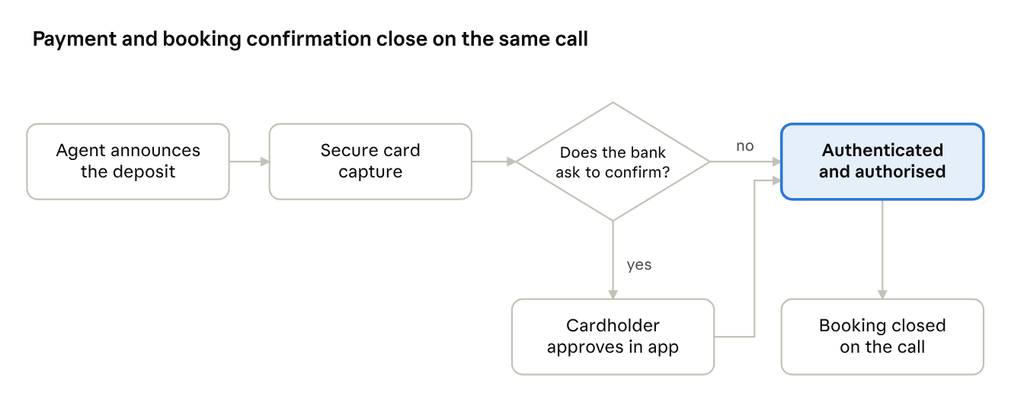
The bank decides whether it needs the cardholder’s involvement. If not, it authenticates frictionlessly; if it does, the cardholder approves in their app without hanging up.
Back to the €1,200 booking. Step by step:
- The agent closes the sale. They have confirmed that the two rooms are connecting and answered the question about a late-night arrival. The customer is ready to pay.
- They announce the deposit. They explain that €400 will be charged and hand over to secure card capture.
- The customer enters the card securely. The details never pass through the agent or the contact centre’s systems.
- The issuing bank authenticates. If it requires the cardholder’s involvement and supports this flow, the customer opens their banking app, checks the merchant and the amount, and approves the €400. It is the same step they already know from online purchases. In other transactions, the issuer authenticates without asking for any action.
- The payment is authorised. The authorisation carries the authentication evidence with it.
- The agent confirms the booking. Everything happens in the same conversation.
For the reservations centre, the benefit is concrete: no room is left on hold waiting for a link the customer still has to open. For Finance, the bank’s authentication is tied to the deposit collected.
The technical framework: a standard that has existed since 2018
Authenticating phone payments does not require inventing anything new: it builds on EMV 3-D Secure, the same standard that protects online purchases.
What the specification says
In December 2018, EMVCo published EMV 3-D Secure 2.2.0. That version brought two key elements for the phone channel:
- Decoupled authentication. It lets the cardholder confirm the payment in their banking app, outside the channel in which the purchase is made.
- The extended 3RI flow. It lets the merchant initiate authentication without the cardholder being on a website, and it includes telephone orders. The specification identifies a Telephone Order with the value 09.
In response to our query, EMVCo stated in writing to Pay by Call that 3RI with that indicator should be sufficient for the phone payment case.
What Visa and Mastercard have confirmed
Visa and Mastercard have confirmed in writing to Pay by Call that phone payments correctly authenticated by the issuer can benefit from liability shift against fraud-related disputes. This applies in both possible cases:
- when the bank authenticates without further interaction (frictionless);
- when the cardholder completes the decoupled confirmation in their app.
For the protection to apply, the payment provider and the acquirer must correctly carry the authentication evidence into the authorisation, in line with each scheme’s rules. That is why authenticating is not enough on its own: the whole chain (platform, PSP and acquirer) must be set up correctly.
How to check it on a real transaction
The CFO can delegate the technical review and ask for one simple check: “Show me where in the PSP report I can see that this €400 deposit was covered by liability shift.”
The answer should link back to both the payment and the booking. An approved payment receipt only shows that the bank authorised the charge. To measure the protection, you also need the authentication evidence and the liability indicator for that transaction.
What liability shift covers and what it does not
Liability shift protects against fraud, not against every dispute. The quickest way to tell whether a case is covered is to look at what the cardholder is disputing:
| What the cardholder says | Type of dispute | Covered by liability shift? | What the hotel should do |
|---|---|---|---|
| “I never authorised that €400” | Fraud / unauthorised transaction | Yes, if the payment was authenticated and obtained liability shift | Provide the authentication evidence through the PSP |
| “Yes, I paid, but I had free cancellation” | Service or cancellation | No | Defend it with the booked rate, the policy communicated and the cancellation date |
| “You charged me the deposit twice” | Duplicate charge | No | Reconcile the two charges and correct the duplicate if needed |
| “I recognise the deposit, but not the €180 for damage” | Later charge | Only if that charge was authenticated separately | Assess the second charge on its own |
One booking reference, several charges
In hotels, a single booking can include several charges, on different dates and even on different cards. Authentication protects each transaction separately, not the booking as a whole.
In our example, the €400 deposit was taken by phone with authentication. The €800 balance was paid at reception with the card present. A later charge for damage would follow its own path. To know which revenue is protected, you have to follow each charge.
How to tell whether it pays off for your hotel
The answer lies in the last twelve months of acquirer settlements. Here is the exercise, in the order it is best done:
- Identify phone payments. Reservations separates payments taken by phone from other channels.
- Find fraud disputes. Finance filters the disputes whose reason was “unauthorised transaction”.
- Add up the real loss. How much was ultimately lost, net of any amounts recovered.
- Add the fees. What the acquirer charged for handling those disputes.
- Check possible coverage. The PSP shows how much of that activity can be processed with authentication and liability shift evidence.
- Break it down by payment type. Deposits, full prepayments, guarantees and later charges.
Step 6 is usually the most revealing. A chain might receive many small cancellation disputes but concentrate almost all of its fraud losses in a few high-value prepayments. In that case, the financial priority is prepaid bookings.
The opposite can also happen: the biggest cost may come from poorly communicated cancellation terms. There, the fix is not authentication but how the customer is informed. Knowing the reason lets you focus effort on the cause that is really eroding margin.
Checklist
- We have identified the payments taken by phone over the last 12 months
- We know how many “unauthorised transaction” disputes we received in that channel
- We know the net loss after recoveries
- We know the chargeback fee agreed with our acquirer
- We have separated deposits, prepayments and later charges
- Our PSP can show the liability shift indicator per transaction
Questions for your PSP or acquirer
The protection depends on the whole payment chain carrying the authentication through correctly. These questions help you check before you start:
- Can you process phone payments with EMV 3DS authentication using 3RI and the Telephone Order indicator (09)?
- Do we carry the authentication evidence into the authorisation in line with Visa and Mastercard rules?
- In which report or field can I see, per transaction, whether a payment obtained liability shift?
- What fee do you charge per chargeback, and does it change if the dispute is resolved in our favour?
- How is each payment linked to the booking reference in your reports?
- When we receive a fraud dispute on an authenticated payment, who provides the evidence and within what timeframe?
Frequently asked questions
Does the customer have to hang up to pay?
No. Card capture and authentication both happen during the call. If the bank asks for confirmation, the customer gives it in their app while still talking to the agent.
How is this different from sending a pay-by-link?
With a payment link, the customer hangs up and pays later, and the booking stays on hold until they do. With PBC 3DS, payment and booking confirmation are completed in the same conversation.
Does the agent see the card details?
No. With PCIaaS secure capture, card details never pass through the agent or the contact centre’s systems. This also reduces the hotel’s PCI DSS scope.
Does it protect against every dispute?
No. Liability shift covers fraud and unauthorised transaction disputes. Cancellation, duplicate and service disputes are still resolved with the booking documentation.
Which card schemes have confirmed it?
Visa and Mastercard have confirmed in writing to Pay by Call that correctly authenticated phone payments can benefit from liability shift, in line with each scheme’s rules.
Is there an extra cost?
PBC 3DS is included at no extra cost for customers of Pay by Call’s PCIaaS platform.
Do I need to change my PSP or acquirer?
Not necessarily. What matters is that your PSP and acquirer carry the authentication evidence into the authorisation. The questions in the previous section help you check this.
From MOTO to ATO: the next step for the reservations centre
At Pay by Call, we combine secure card data capture through PCIaaS with PBC 3DS bank authentication (patent pending), included at no extra cost for customers of our PCIaaS platform.
For a hotel already using the platform, the conversation with Finance can start with a single figure: how much money it lost last year on phone payments that the cardholder denied authorising. For a hotel not yet using it, that same figure is the best way to judge whether it pays off.
The next time a family calls to book two rooms, the commercial goal will be the same: answer their questions and close the stay. The difference is that, before saying goodbye, the agent can confirm the payment and the hotel will have bank authentication tied to that deposit. If, weeks later, the cardholder disputes the €400 as fraud and the transaction obtained liability shift, the hotel can keep the revenue from a booking it has already served.
Want to estimate the savings for your hotel or chain? Write to info@paybycall.com and we will review it with your data.