
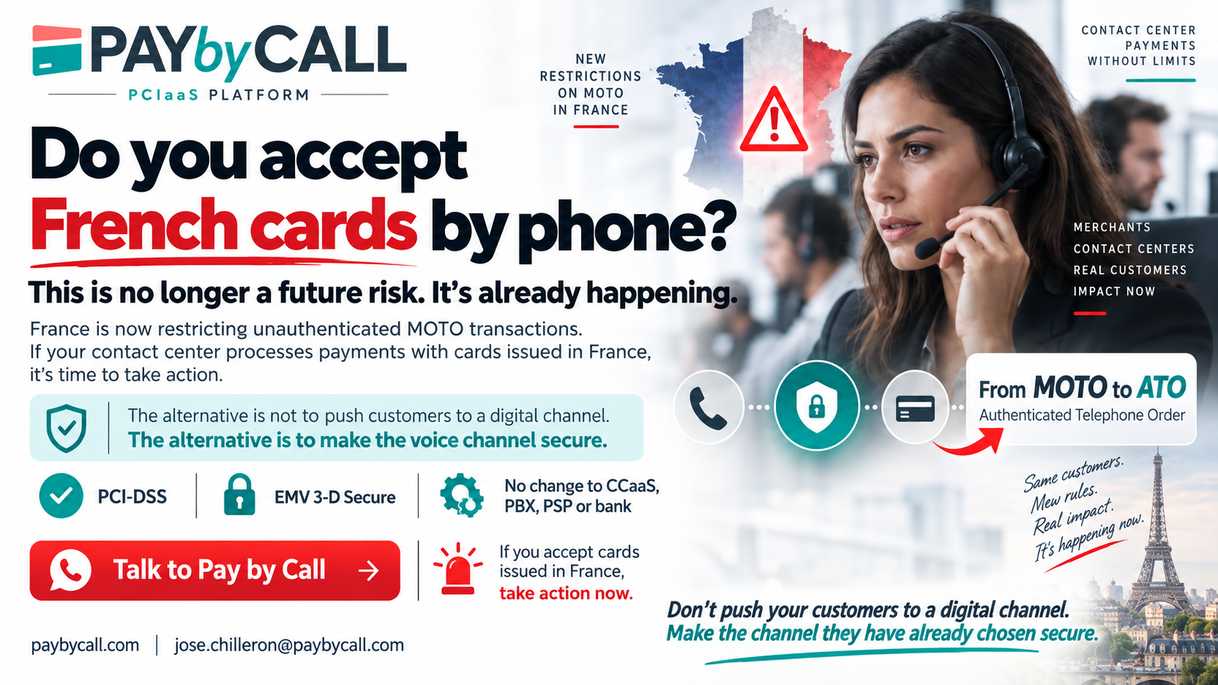
France is progressively restricting unauthenticated MOTO transactions. Insurance, utilities and telecommunications are already operating under the €500 velocity threshold, while airlines, hotels, travel companies and other sectors entered the final phase of the transition in September 2026. The alternative to removing telephone payments may be to authenticate them.
Updated: 13 September 2026
For many years, telephone payments have occupied a peculiar position within the card-payment ecosystem.
They remain commercially necessary in industries where customers still choose to speak to an agent before completing a purchase, paying a bill, renewing a policy, modifying a reservation or resolving a debt. Yet, from a security and authentication perspective, traditional Mail Order / Telephone Order (MOTO) transactions have evolved much more slowly than e-commerce.
That gap is becoming increasingly difficult to ignore.
France is currently implementing one of the most significant initiatives in Europe aimed at reducing fraud in remote card payments performed outside 3-D Secure. The measures promoted by the Observatoire de la sécurité des moyens de paiement (OSMP) are particularly relevant to Telephone Order transactions.
The direction is clear: maintaining an unauthenticated telephone-payment channel is becoming progressively harder, especially for higher-value transactions.
And this is not necessarily a French merchant issue.
For companies operating elsewhere in Europe, the relevant question may no longer be:
“Do we operate in France?”
but rather:
“Do we accept cards issued in France over the telephone?”
That distinction matters.
1. What is MOTO and why does it still exist?
MOTO stands for Mail Order / Telephone Order.
Historically, it describes card-not-present transactions where the cardholder provides the payment information through channels such as telephone or mail rather than through an online checkout.
In the telephone environment, this typically means that a customer speaks to an agent—or interacts with an IVR—and provides the card details required to complete a payment.
MOTO has survived because the telephone channel itself has survived.
That is particularly visible in insurance, travel, hospitality, utilities, healthcare, public services, debt collection and transportation.
Customers do not always begin their journey on a website.
They call because they have a question, need assistance, want to modify something, have accessibility requirements, are uncomfortable with digital channels or simply prefer speaking to another person.
The problem, therefore, is not necessarily the telephone.
The problem is that the traditional MOTO model was created at a time when real-time strong authentication of the cardholder was not part of the payment journey.
2. E-commerce evolved. Telephone payments largely did not.
The transformation of e-commerce payments over the last decade has been substantial.
EMV® 3-D Secure and Strong Customer Authentication have allowed issuers to participate directly in authenticating the cardholder before authorisation.
Telephone payments, however, have traditionally remained outside that authentication experience.
The result is an increasingly visible security asymmetry:
online payment → cardholder authentication
traditional telephone payment → card data, but generally no equivalent real-time authentication
This distinction is particularly relevant because protecting card data and authenticating the customer are not the same thing.
A telephone environment can be designed to protect card information in accordance with PCI DSS and still process a transaction without authenticating the cardholder through an issuer-led SCA mechanism.
France is now addressing precisely that gap.
3. Why France is focusing on remote payments outside 3-D Secure
The French payment-security authorities have been paying increasing attention to card transactions performed outside 3-D Secure.
The OSMP action plan targets remote payment scenarios where authentication is absent or where transactions take place outside the protections normally associated with EMV 3-D Secure.
Its concern is supported by the fraud data.
According to the OSMP’s latest reporting, remote card payments continue to account for a disproportionately large share of card fraud when compared with their share of payment value.
Particularly exposed categories include MOTO transactions, Internet payments performed without SCA outside 3-D Secure, and certain merchant-initiated transactions.
The comparison with authenticated e-commerce is important.
In France, the fraud rate for remote non-Internet card payments associated with MOTO-type activity increased from approximately 0.271% in 2024 to 0.322% in 2025, while the fraud rate for Internet card payments decreased from approximately 0.155% to 0.124% over the same period.
The numbers should not be interpreted as suggesting that 3-D Secure eliminates fraud.
It does not.
But they reinforce a broader European conclusion: authentication materially changes the risk profile of remote card payments.
4. The European evidence points in the same direction
France is not acting in isolation from the wider European payment-security debate.
The European Central Bank and European Banking Authority have repeatedly highlighted the effectiveness of Strong Customer Authentication in reducing fraud in electronic payments.
Their joint fraud analysis for the European Economic Area showed that card fraud is significantly higher in scenarios where SCA is not legally required or is not commonly applied.
One particularly striking comparison concerns transactions where the payee is located outside the EEA: card fraud rates can be dramatically higher when SCA is absent.
This does not mean every payment channel must become a browser-based e-commerce experience.
It means something more fundamental:
the payment ecosystem is increasingly distinguishing between authenticated and unauthenticated remote payments.
That distinction is now reaching the telephone.
5. France’s response: progressively limiting unauthenticated MOTO
One of the mechanisms adopted by the OSMP is a velocity limit.
This concept is sometimes misunderstood.
The limit is not simply a maximum amount for a single transaction.
For the purposes of the French framework, velocity is based on the cumulative value of transactions performed with the same card at the same merchant during a rolling 24-hour period.
Issuer PSPs are encouraged to reject transactions that cause the applicable threshold to be exceeded, using a soft decline where possible.
This creates a very practical consequence.
A merchant may be able to process a €300 Telephone Order transaction and later find that another payment from the same card causes the 24-hour cumulative amount to exceed the permitted threshold.
The impact can therefore appear inside ordinary contact-centre workflows rather than only in unusually large individual transactions.
6. The €500 threshold is already operational in several sectors
The OSMP has progressively withdrawn sector exemptions from the general €500 MOTO velocity limit.
For a first group of industries, the reduction took place in stages:
| Sector examples | 12 Nov 2025 | 10 Feb 2026 | 11 May 2026 |
|---|---|---|---|
| Insurance | €2,000 | €1,000 | €500 |
| Telecommunications | €2,000 | €1,000 | €500 |
| Electricity, gas and water | €2,000 | €1,000 | €500 |
| Financial institutions | €2,000 | €1,000 | €500 |
| Higher education | €2,000 | €1,000 | €500 |
| Social and charitable organisations | €2,000 | €1,000 | €500 |
This means that, as of September 2026, sectors such as insurance, utilities and telecommunications are already operating at the €500 threshold for the relevant unauthenticated MOTO transactions.
For merchants in those sectors, this is not a future scenario.
It is already part of the operating environment.
7. Travel, airlines, hotels and transportation are now entering the critical phase
A second group of sectors was given a later implementation timetable.
This group includes some of the industries most dependent on telephone-assisted payments: airlines, hotels, car rental, rail transport, maritime transport, travel agencies and certain debt-collection activities.
Their transition is particularly relevant during the second half of 2026.
The timetable is:
| Sector group | 12 Nov 2025 | 10 Sep 2026 | 12 Oct 2026 | 12 Nov 2026 |
|---|---|---|---|---|
| Airlines | €4,000 | €2,000 | €1,000 | €500 |
| Hotels | €4,000 | €2,000 | €1,000 | €500 |
| Car rental | €4,000 | €2,000 | €1,000 | €500 |
| Rail transport | €4,000 | €2,000 | €1,000 | €500 |
| Maritime transport | €4,000 | €2,000 | €1,000 | €500 |
| Travel agencies | €4,000 | €2,000 | €1,000 | €500 |
| Debt collection | €4,000 | €2,000 | €1,000 | €500 |
On 10 September 2026, these sectors moved to a €2,000 threshold.
One month later, on 12 October, that threshold falls to €1,000.
On 12 November 2026, it reaches €500.
For industries such as aviation, hospitality and travel—where telephone transaction values can easily exceed these levels—the strategic relevance is obvious.
8. This is not simply about merchants located in France
One of the most important aspects of the French framework is geographical scope.
The measures are linked primarily to cards issued by payment service providers authorised or established in France, rather than simply to the physical location of the merchant.
The OSMP framework also addresses acquiring arrangements across the European Economic Area and, under the updated roadmap, certain transactions involving merchants and acquiring PSPs in the United Kingdom and Switzerland.
Consequently, a merchant headquartered in Spain, Germany, Italy or another European country may still need to consider the French measures if it accepts cards issued in France.
This makes the issue especially relevant to multinational organisations.
An airline based in Spain may serve French customers.
A hotel group in Portugal may take telephone bookings from French cardholders.
A Spanish insurer may serve customers carrying French-issued cards.
A European contact centre may process payments on behalf of several brands across multiple jurisdictions.
The telephone call does not need to originate in France for the underlying card relationship to become relevant.
9. What happens when the threshold is exceeded?
The intention is not simply to record excessive MOTO activity.
Issuer PSPs are encouraged to prevent transactions that exceed the applicable velocity threshold.
Where technically possible, the refusal can be performed using a soft decline, potentially giving the payment chain the opportunity to apply an appropriate authentication mechanism.
This is why the issue should be considered operational rather than purely regulatory.
The consequences may eventually be visible to the customer and the contact-centre agent:
a payment is attempted;
the transaction is rejected;
the agent does not necessarily understand why;
the customer is asked to retry;
or the payment journey is moved into another channel.
What initially appears to be a payments-policy issue can therefore become a conversion, customer-experience and contact-centre productivity issue.
10. France is not simply saying “stop accepting telephone payments”
This is perhaps the most important point.
The French approach does not suggest that the telephone channel itself must disappear.
In fact, the OSMP recommendations recognise that Telephone Order continues to have legitimate use cases.
Recommendation No. 1 encourages the industry to reserve MOTO for genuine situations where another payment method is not reasonably available and to avoid using it as a way to bypass SCA for what are effectively Internet-originated customer transactions.
That is significantly different from saying:
“All customers must be sent to a website.”
The French framework is increasingly pointing towards another possibility:
authenticate the telephone payment.
11. Recommendation No. 4: securing the card data
Authentication is only one part of the problem.
The OSMP also addresses how payment information is collected during a telephone interaction.
Recommendation No. 4 promotes mechanisms that, whenever possible, allow the customer to communicate card information directly to a secure technical system rather than verbally to an agent.
Examples include keypad-based DTMF capture and voice-recognition technologies.
This approach is consistent with established PCI DSS principles.
If sensitive payment data enters the contact-centre environment, the infrastructure handling those data may fall within PCI DSS scope.
Removing cardholder data from the agent desktop, call recording and contact-centre infrastructure can therefore significantly reduce risk and PCI scope.
But this produces an important distinction:
PCI DSS protects the payment data.
SCA / 3-D Secure authenticates the cardholder.
A modern secure telephone-payment architecture increasingly needs to consider both.
12. Recommendation No. 5: the crucial step towards authenticated Telephone Order
Recommendation No. 5 is particularly significant.
The OSMP encourages merchants and payment service providers to experiment with authentication methods adapted to remote-payment channels and customer profiles.
More importantly, it explicitly calls on the ecosystem—including schemes, PSPs, technology providers and standardisation bodies—to work towards a Strong Customer Authentication solution for Telephone Order during 2026.
This changes the nature of the discussion.
The question is no longer simply:
“How can MOTO fraud be limited?”
It becomes:
“How can a Telephone Order transaction be strongly authenticated?”
That is a very different technological challenge.
13. Authenticated Telephone Orders are treated differently
The evolution became even clearer in the OSMP’s 2025 annual report, published in September 2026.
The report states that Telephone Order transactions initiated by telephone but authenticated through 3-D Secure are excluded from the €500 MOTO velocity limit.
That distinction is strategically important.
It means that France is no longer treating every telephone-originated card payment as an equivalent risk category.
The model increasingly separates:
unauthenticated MOTO
from
telephone transactions in which the cardholder is strongly authenticated.
This is precisely the conceptual transition that Pay by Call describes as moving from MOTO to ATO — Authenticated Telephone Order.
14. ATO is a proposed term, not an official regulatory category
Terminology matters.
ATO — Authenticated Telephone Order is terminology proposed by Pay by Call to describe a telephone-originated payment in which the cardholder is authenticated in real time through an SCA / EMV 3-D Secure process.
ATO is not currently an official OSMP, EBA, EMVCo, Visa or Mastercard transaction category.
We use the term because the industry needs a concise way to distinguish two fundamentally different experiences:
traditional MOTO, where the merchant possesses card data but does not perform issuer-led cardholder authentication;
and an authenticated telephone transaction, where the order still begins in the voice channel but the cardholder completes authentication before authorisation.
The commercial channel remains telephone.
The security model changes.
15. Does using 3-D Secure turn a Telephone Order into e-commerce?
This is one of the most interesting questions raised by the evolution of the channel.
The telephone is the commercial interaction and card-data capture channel.
It does not necessarily have to define the technical authentication method used later in the payment flow.
A customer may speak to an agent, provide card data within a PCI-compliant environment and then complete an issuer-led authentication process before the transaction is submitted for authorisation.
This creates an important conceptual separation:
channel used to place the order
versus
mechanism used to authenticate the payer.
The European regulatory debate is increasingly recognising this distinction.
MOTO does not necessarily need to mean “unauthenticated”.
16. EMV 3-D Secure is not inherently limited to a web browser
Many organisations still associate 3-D Secure exclusively with an online checkout.
That perception reflects the historical adoption of 3DS, but it does not fully describe the architecture of EMV 3-D Secure.
EMVCo has developed authentication mechanisms designed for scenarios where a conventional browser-based challenge is not available or appropriate.
Decoupled Authentication, for example, allows issuer authentication to occur independently from the merchant’s immediate user interface.
EMVCo itself identifies scenarios involving voice interfaces and MOTO-like environments as examples where this type of authentication can be relevant.
This does not mean that any telephone payment automatically qualifies for a particular scheme treatment.
Nor does it automatically guarantee liability shift.
Those outcomes depend on scheme rules, transaction indicators, issuer/acquirer implementation and the precise technical flow.
But it does demonstrate something fundamental:
3-D Secure does not inherently require the commercial journey to become a conventional web checkout.
17. The technical challenge is not merely “sending a 3DS request”
This distinction is important when evaluating telephone-payment technology.
Applying 3-D Secure to an active call is not simply a matter of initiating an authentication message.
The difficult problem is maintaining and synchronising two asynchronous environments:
the real-time voice session
and the issuer authentication process.
The voice session must remain active while the issuer interacts with the cardholder.
The payment transaction must be correlated with the correct call.
The system must recognise when authentication has finished.
The authentication result must be associated with the correct transaction.
The transaction must then continue to authorisation.
And the customer must be returned seamlessly to the voice experience without losing context or breaking the interaction.
This orchestration problem is at the heart of PBC 3DS.
18. Pay by Link is valid—but it changes the journey
Pay by Link has become one of the industry’s most common responses to the difficulty of securing telephone payments.
The approach is understandable.
When a customer needs to pay, the agent sends a link by SMS, email or messaging application.
The customer opens the link.
The telephone conversation is effectively interrupted while the payment moves to a web environment.
The customer enters the payment credentials and, if necessary, completes 3-D Secure authentication.
Technically, that can be secure and effective.
From a customer-journey perspective, however, something has changed.
The customer chose the telephone channel.
The merchant has transferred the customer to another channel in order to complete the payment.
Sometimes that is exactly what the customer wants.
Sometimes it introduces unnecessary friction.
The strategic question should therefore not be:
“Is Pay by Link secure?”
It can be.
The better question is:
“Should every secure telephone payment require abandoning the telephone experience?”
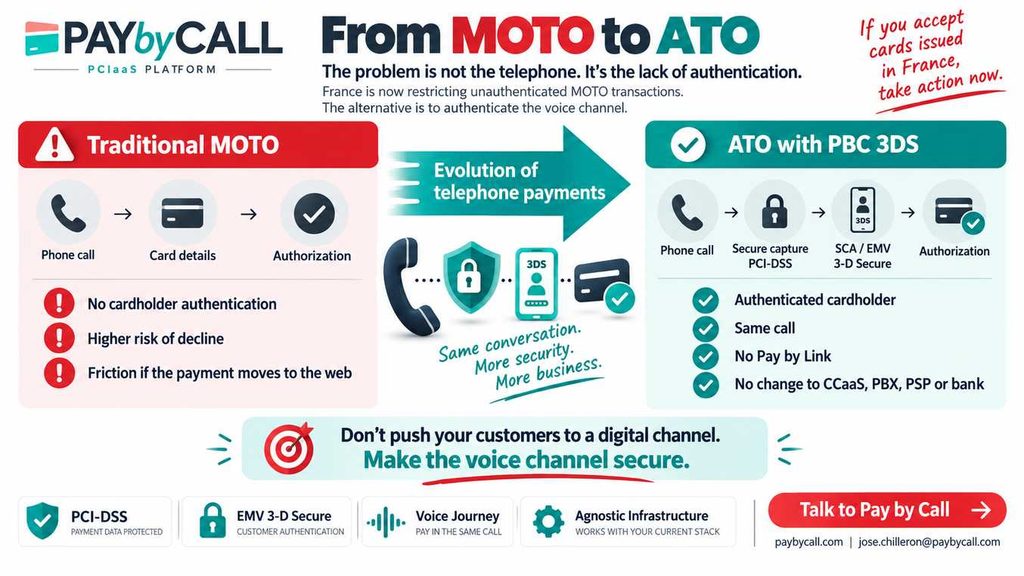
19. From MOTO to ATO: preserving the voice journey
Pay by Call’s answer is that the telephone journey can itself become secure and authenticated.
We describe that evolution as:
MOTO → ATO
Mail Order / Telephone Order
becomes
Authenticated Telephone Order
The objective is not to transform the telephone into a website.
The objective is to allow the payment to benefit from modern authentication while preserving the voice interaction selected by the customer.
In practical terms:
secure the card data;
authenticate the cardholder;
preserve the telephone channel.
20. What PBC 3DS does
PBC 3DS is Pay by Call’s patent-pending technology for orchestrating EMV 3-D Secure authentication during a real-time voice-payment session.
The architecture is designed to maintain the call while authentication takes place.
Card information can be collected through a PCI DSS-compliant environment without exposing sensitive data to the contact-centre agent.
The transaction is correlated with the active voice session.
The cardholder completes issuer authentication.
The authentication result is returned asynchronously.
PBC 3DS associates that result with the original payment and active call.
The transaction can then proceed to authorisation and the result can be communicated within the same telephone journey.
The customer does not need to be sent to a conventional Pay by Link checkout simply because SCA is required.
21. Pay by Call is not a PSP
This is equally important for enterprise architecture.
Pay by Call is not a Payment Service Provider.
The objective is not to replace the merchant’s existing payment infrastructure.
PBC operates as a secure technology layer between the voice channel and the payment ecosystem already selected by the merchant.
A company can therefore retain its existing:
bank, acquirer, PSP, CCaaS platform, PBX and contact-centre infrastructure.
This is particularly important for large organisations.
Payments infrastructures are rarely replaced simply because one channel requires improvement.
Banks, airlines, insurers, utilities and public-sector organisations often operate complex stacks built over many years.
A realistic transformation strategy must therefore integrate with the stack rather than require the stack to be replaced.
22. Why an agnostic architecture matters
The future of payments will not be built around a single channel.
Customers will continue moving between web, mobile applications, messaging, telephone, conversational AI and physical environments.
The strategic objective should therefore be to make each relevant channel capable of completing a payment securely.
For the telephone channel, this means decoupling the security layer from the underlying contact-centre platform.
PBC 3DS is designed to operate as an orchestration layer rather than as a replacement for CCaaS, PBX, PSP or acquiring infrastructure.
That approach is especially relevant to enterprises operating multiple contact centres, outsourced BPO environments or several PSP relationships.
The question is no longer simply:
“Which payment method should we choose?”
Increasingly, the answer is:
make all relevant payment methods available within a common stack.
23. What should a merchant accepting French-issued cards review today?
A merchant does not need to wait for widespread transaction declines before analysing its exposure.
A practical review should include:
- whether telephone payments are currently processed as MOTO;
- whether cards issued in France represent a meaningful part of the customer base;
- average and maximum telephone transaction values;
- cumulative payment values per card within 24 hours;
- the MCCs used by the business;
- current acquiring and PSP configuration;
- whether 3-D Secure can be initiated from the existing payment architecture;
- whether card data enter the agent desktop, call recordings or CCaaS environment;
- whether Pay by Link is currently used as the only mechanism for authenticating a customer during a call;
- and whether the organisation has a roadmap for authenticated Telephone Order.
For some organisations, this analysis will remain primarily a risk-management exercise.
For others, particularly those with high telephone ticket values, it may become a conversion issue very quickly.
24. Insurance deserves particular attention
Insurance is a useful example because the sector reached the €500 threshold on 11 May 2026.
Telephone-assisted payments remain common in insurance.
Customers may call to purchase a policy, renew cover, change contractual details or resolve an issue with an agent.
The value involved can easily exceed €500.
If an insurer operates under the assumption that its telephone-payment architecture can remain indefinitely unauthenticated, the French market is now providing a practical reason to reconsider that assumption.
The choice should not necessarily be between:
accepting insecure telephone payments
and
forcing every caller onto the web.
There is a third architectural possibility:
authenticate the telephone payment.
25. Travel and hospitality may feel the effect even more strongly
Travel-related transactions deserve equal attention because of their typically higher ticket values.
Airlines, hotels, rail operators, ferry companies, car-rental businesses and travel agencies frequently use telephone channels for complex or high-value transactions.
Customers may call because an itinerary needs to be changed, a booking involves several passengers, a disruption has occurred or the transaction is too complex for self-service.
Those are precisely the situations where sending the customer away from the agent can create friction.
And the French timetable is now accelerating.
The threshold fell to €2,000 on 10 September 2026.
It falls to €1,000 on 12 October.
It reaches €500 on 12 November.
For the travel industry, authenticated telephone payments are therefore moving from theoretical interest towards a very practical operating question.
26. Security and conversion should not be treated as opposing objectives
Payments teams have historically been forced to balance two priorities:
security
and
conversion.
More security often meant more friction.
Less friction could mean more risk.
Modern authentication attempts to reduce that trade-off.
The ideal payment journey is not merely secure.
It is secure within the context the customer has already chosen.
If a customer is already talking to an agent, requiring that customer to stop the conversation, locate a message, open a link, understand a separate interface and then return to the conversation introduces extra steps.
Every additional transition is a potential point of abandonment.
The better technical question is therefore:
can authentication be added without destroying continuity?
That is the design principle behind native authentication within the voice journey.
27. From Contact Centre to Commerce Centre
The implications go beyond fraud prevention.
For decades, the Contact Centre has frequently been treated as a cost centre.
Its role was support.
Sales and payments increasingly moved toward digital channels.
Conversational AI may change that model.
As customers become more comfortable interacting with human agents, virtual agents and AI assistants through natural conversation, voice can again become a transactional interface.
But a conversational interface that cannot securely complete a payment remains incomplete.
To become a Commerce Centre, the Contact Centre needs more than conversation.
It needs identity, authentication and payment capabilities.
Secure telephone payments are therefore not simply about preserving an old channel.
They may become an important building block of future conversational and agentic commerce.
28. The arrival of AI makes authentication even more important
Voice AI makes the issue more strategic, not less.
A conversational AI agent can already answer questions, access customer information, manage bookings, modify services and initiate commercial processes.
The logical next step is transaction completion.
But allowing AI to request or handle card information without an appropriate security and authentication architecture would reproduce the weaknesses of traditional telephone commerce at a much larger scale.
The emergence of AI therefore strengthens the need to separate three functions clearly:
conversation,
secure card-data capture,
and
cardholder authentication.
A voice AI system does not need to become a PSP.
Nor should a CCaaS platform need to store sensitive card data.
A specialised payment layer can provide the secure bridge between conversation and the financial infrastructure.
29. France may be showing where Europe is heading
It would be inaccurate to say that Europe has already imposed a general requirement for 3-D Secure on every MOTO transaction.
It has not.
The French OSMP measures should also not be described as a new European law.
They are part of a French action plan and supervisory/payment-industry framework designed to reduce fraud in remote card payments outside 3-D Secure.
Nevertheless, France matters.
The country has repeatedly played an influential role in European payment security.
Its current approach introduces a powerful principle:
a Telephone Order transaction that is authenticated should not necessarily be treated in the same way as an unauthenticated MOTO transaction.
If that principle proves effective, it is reasonable to expect other markets, issuers, acquirers and payment networks to study the results closely.
30. The €500 limit may not be the final destination
There is another important element in the OSMP roadmap.
Once authenticated Telephone Order solutions become sufficiently deployed, effective and accessible, the French authorities have indicated that they may consider progressively lowering the velocity threshold below €500 for MOTO transactions that do not pass through 3-D Secure.
That possibility changes the strategic interpretation of the current limits.
€500 should not necessarily be viewed as a permanent safe harbour for unauthenticated MOTO.
It may instead represent an intermediate stage in a broader migration towards authenticated remote payments.
For merchants with significant telephone-payment activity, waiting until limits tighten further may therefore be the least efficient strategy.
31. What happens to MOTO?
MOTO is unlikely to disappear overnight.
There are legitimate business and accessibility reasons for retaining the telephone channel.
The more plausible evolution is that the industry begins distinguishing more clearly between:
traditional unauthenticated MOTO
and
authenticated Telephone Order.
The first relies mainly on possession of card data.
The second combines secure data capture with real-time authentication of the cardholder.
That is a fundamental shift.
The telephone remains.
The payment becomes stronger.
From MOTO to ATO
At Pay by Call, we believe this is the natural evolution of the channel.
ATO — Authenticated Telephone Order describes a telephone-payment experience in which the customer can remain within the voice journey while the payment benefits from PCI DSS protection and EMV 3-D Secure authentication.
PBC 3DS has been designed specifically to orchestrate that process.
The objective is not to force merchants to replace their payment infrastructure.
It is to add authentication to the channel they already operate.
No change of bank.
No change of PSP.
No change of acquiring relationship.
No change of CCaaS or PBX.
And, where the business journey requires it:
no need to force the customer into a web checkout simply to authenticate the payment.
Conclusion: make the channel secure rather than removing the channel
France is sending an important message to the European payments industry.
The problem is not that customers still pay by telephone.
The problem is that too many telephone payments are still processed without the authentication standards that have become normal elsewhere in card-not-present commerce.
The answer does not have to be to eliminate the voice channel.
It can be to modernise it.
For merchants, PSPs, acquirers, banks, CCaaS providers and Contact Centres, the strategic question is increasingly straightforward:
If a customer chooses to pay by telephone, why should security require sending that customer somewhere else?
At Pay by Call, our answer is:
Secure the card data. Authenticate the cardholder. Preserve the telephone channel.
And that is what we mean by moving:
From MOTO to ATO.
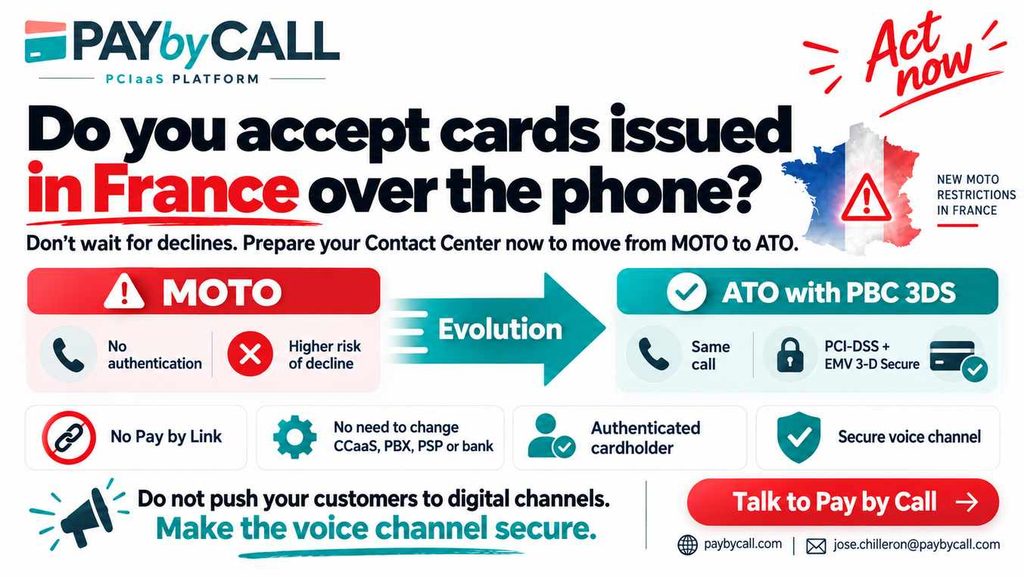
Do you accept French-issued cards over the telephone?
If your organisation processes telephone payments in insurance, travel, airlines, hospitality, utilities, transportation, debt collection, public services or any other sector exposed to MOTO transactions, now is the time to review your architecture.
Pay by Call can help you analyse how PCI DSS and SCA / EMV 3-D Secure can be incorporated into the voice channel while preserving your existing payment and contact-centre infrastructure.
Do not push customers towards a digital channel simply because they need to pay.
Make the channel they have already chosen secure.
Talk to Pay by Call
paybycall.com
jose.chilleron@paybycall.com
PBC 3DS — Secure the card data. Authenticate the cardholder. Preserve the telephone channel.
Regulatory and terminology note
The measures discussed in this article form part of the French OSMP action plan and recommendations concerning remote card payments outside 3-D Secure. They should not be described as an EU-wide legal prohibition of MOTO.
ATO — Authenticated Telephone Order is terminology proposed by Pay by Call and is not currently an official transaction category defined by the OSMP, EBA, EMVCo, Visa or Mastercard.
PBC 3DS is patent pending. The technology is the subject of patent applications filed by Pay by Call in Spain and through international and European patent procedures. Patent-pending status should not be interpreted as a granted patent or as regulatory or card-scheme approval.