
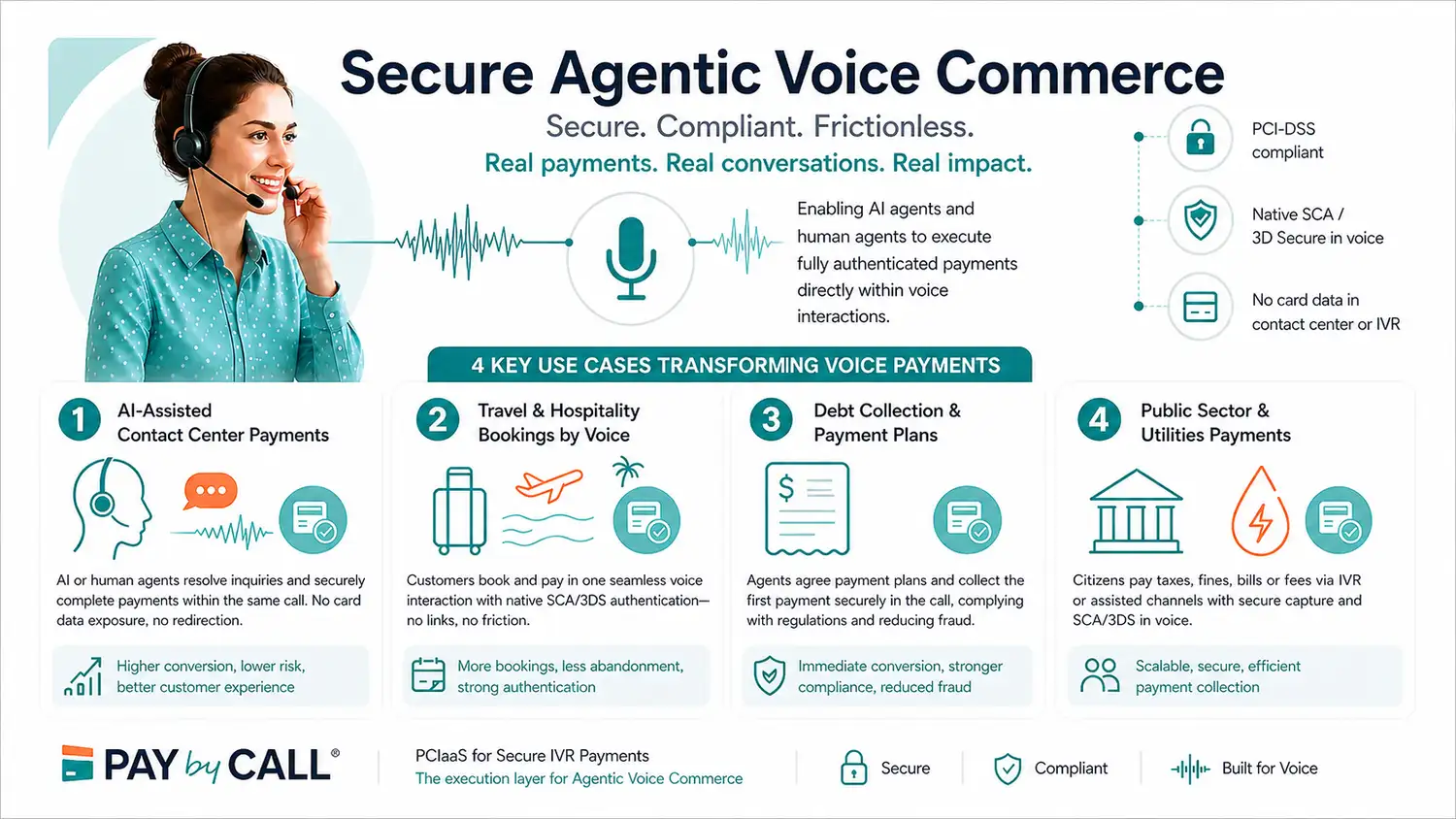
Artificial intelligence is beginning to reshape commerce.
AI agents are increasingly able to search, compare, recommend, assist, negotiate and initiate transactions on behalf of users or businesses. This emerging model is often referred to as agentic commerce: a new paradigm where AI systems do not simply provide information, but actively participate in commercial workflows.
Most of the current debate around agentic commerce focuses on web, app and wallet-based environments. That is understandable. Digital commerce is the most visible arena for AI-driven transaction flows.
But it is not the whole economy.
A significant share of real-world commercial activity still happens through voice channels: contact centers, IVR systems, customer service lines, collection departments, travel reservation desks, healthcare providers, utilities, insurance companies and public sector helplines.
In these environments, payments are still often completed through legacy models such as MOTO, manual card handling, or pay-by-link redirections. These methods create friction, increase fraud exposure, expand PCI-DSS scope and break the customer journey at the most critical moment: the moment of payment.
This is where a new category begins to emerge:
Agentic Voice Commerce — the ability for AI-assisted, human-assisted or fully automated voice interactions to complete secure, authenticated and compliant payments directly within the voice channel.
For Agentic Voice Commerce to scale, AI is not enough. The ecosystem needs a secure execution layer.
That is the role of Pay by Call and its PCIaaS platform, PaybyCall. And it is where PBC 3DS, Pay by Call’s patent-pending native SCA / 3D Secure solution for the voice channel, becomes especially relevant.
1. From Agentic Commerce to Agentic Voice Commerce
Agentic commerce changes the role of software in the buying process.
Traditionally, the customer performs the commercial journey manually:
- Searches for a product or service
- Compares options
- Selects a provider
- Enters payment details
- Confirms authentication
- Completes the transaction
In an agentic commerce model, AI can assist or automate several of these steps.
An AI agent may identify the best supplier, recommend an option, prepare the transaction, interact with a merchant system and initiate the payment process. This can dramatically reduce friction and coordination costs between consumers, merchants, platforms and payment providers.
However, there is a major limitation.
Most AI commerce flows are still designed around digital interfaces: web checkout, mobile apps, embedded wallets, card-on-file environments or API-driven payment flows.
But many high-value, high-trust and operationally complex transactions still happen through voice.
Examples include:
- A customer calling a utility company to pay an overdue bill
- A citizen paying a municipal fee through an IVR system
- A traveler confirming a booking over the phone
- A patient paying for a private healthcare appointment
- A customer negotiating a payment plan with a collection agent
- An insurance policyholder completing a premium payment during a service call
These are not marginal use cases. They are everyday payment scenarios.
The problem is that the voice channel has historically been treated as a secondary or legacy channel in the payments ecosystem. Agentic commerce changes that.
If AI agents are going to interact with humans, businesses and service platforms across multiple channels, then voice must become transaction-ready.
That requires more than conversational AI: It requires secure payment execution inside voice interactions.
2. The Current Problem: Voice Payments Still Depend on Legacy CNP Models
Voice payments are usually classified within the broader category of CNP — Card Not Present — payments.
In CNP environments, the cardholder and the physical card are not present at a point-of-sale terminal. This includes e-commerce, app payments, telephone payments, MOTO transactions and certain remote payment flows.
In the voice channel, many organizations still rely on one of three traditional approaches:
2.1 Manual MOTO Card Capture
In a traditional MOTO flow, the customer provides card details verbally to an agent, who then enters them into a payment terminal or virtual POS.
This creates several problems:
- The agent may hear or see sensitive card data
- The contact center environment may enter PCI-DSS scope
- Call recordings may capture sensitive information
- The merchant increases its compliance burden
- Fraud and dispute risk can increase
- Customer trust may be reduced
“For organizations operating at scale, this model is increasingly difficult to justify.”
2.2 DTMF Masking Without Full Authentication
Some contact centers use DTMF masking, where the customer enters card details through the telephone keypad and tones are masked from the agent and recording systems.
This is a significant improvement over manual card capture, but it does not solve all challenges.
In many cases, the payment may still be treated as a standard MOTO or CNP transaction. The flow may reduce PCI exposure, but it does not necessarily provide native SCA / 3D Secure authentication within the call.
“As commerce becomes more AI-assisted and fraud more sophisticated, secure capture alone may not be enough.”
2.3 Pay-by-Link Redirection
Another common solution is to send the customer a payment link via SMS or email.
This approach can work well in some scenarios, but it introduces a channel switch:
- The customer must leave the call
- Open an SMS or email
- Trust the link
- Complete a web checkout
- Possibly go through 3D Secure authentication
- Return to the original conversation
“Every additional step increases abandonment risk”.
In high-intent voice interactions, this is particularly problematic. The customer is already engaged. The agent or AI assistant has already brought the customer to the point of payment. Redirecting them away from the call breaks the flow at the worst possible moment.
In Agentic Voice Commerce, this becomes even more critical.
“If AI can manage the conversation but cannot securely complete the payment within that same environment, the transaction remains fragmented.”
3. The Missing Layer: Secure Payment Execution in Voice
The future of AI-driven commerce will not only depend on intelligence. It will depend on execution.
AI can identify intent.
AI can guide the customer.
AI can recommend a product or service.
AI can initiate a workflow.
But when the moment of payment arrives, the system must answer four fundamental questions:
- Can the payment be executed securely?
- Can sensitive card data be protected?
- Can the transaction be authenticated?
- Can the experience remain frictionless for the customer?
In web and app environments, the industry has built strong mechanisms around tokenization, 3D Secure, wallet authentication, embedded checkout and payment orchestration.
“Voice needs an equivalent execution layer”.
This is where PCIaaS — Compliance-as-a-Service — becomes strategically relevant.
Rather than forcing each merchant, contact center or BPO to build and maintain complex PCI-DSS environments, a PCIaaS model allows the secure payment execution layer to be externalized through a specialized platform.
In other words, the merchant can keep the customer interaction, while the PCIaaS provider handles the secure capture, processing and compliance-sensitive part of the transaction.
That is the core role of PaybyCall.
4. Pay by Call’s Role: PCIaaS for Secure IVR Payments
Pay by Call SL is a specialized technology company focused on Secure IVR Payments.
Its platform, PaybyCall, operates as a PCIaaS — Compliance-as-a-Service — layer for voice payments. It enables contact centers, BPOs, merchants, public institutions and service providers to process card payments through voice channels without exposing sensitive card data to agents, call recordings or internal systems.
The platform is designed to protect the payment interaction and capture card data securely, allowing payment service providers and acquirers to execute the transaction safely.
This positioning is important:
Pay by Call is not a generalist PSP trying to replace existing payment providers. Instead, it complements PSPs, gateways, acquirers, BPOs, CCaaS platforms and contact center environments by solving a very specific and difficult problem:
How to make voice payments secure, compliant, scalable and conversion-friendly.
In the context of Agentic Voice Commerce, that role becomes even more strategic.
If AI assistants begin to operate in customer service, collections, travel, insurance, healthcare or public administration, they will need a secure way to trigger or complete payments in the voice channel.
PaybyCall can provide that execution layer.
5. PBC 3DS: Native SCA / 3D Secure Authentication in the Voice Channel
The most distinctive element in Pay by Call’s roadmap is PBC 3DS.
PBC 3DS is Pay by Call’s patent-pending native SCA / 3D Secure solution for the voice channel.
Its purpose is to solve one of the most difficult problems in remote voice payments:
How can a customer complete strong customer authentication (SCA/3D Secure) within a call, without being redirected to a web or app flow?
In many current payment journeys, 3D Secure authentication is designed for digital interfaces. The customer is redirected to a browser or app-based authentication step, where they approve the transaction through their bank, banking app or authentication method.
That model works in e-commerce. But in voice, it often breaks the flow.
“PBC 3DS aims to bring authentication into the voice interaction itself, enabling SCA / 3D Secure without forcing the customer to abandon the call.”
This matters for several reasons:
5.1 It Preserves Customer Intent
In a voice interaction, the customer is often at peak intent. They are speaking with an agent, an IVR system or an AI assistant. The reason for the call has been identified. The amount is known. The customer is ready to pay. Redirecting the customer to another channel introduces unnecessary friction. PBC 3DS is designed to preserve the continuity of the interaction.
5.2 It Reduces Channel-Switching Friction
Channel switching is one of the main weaknesses of pay-by-link flows.
A customer may not receive the SMS.
They may distrust the link.
They may open it later.
They may abandon the checkout.
They may fail authentication.
They may call again.
“A native in-call authentication flow avoids that fragmentation”.
5.3 It Strengthens Trust and Authentication
Traditional voice MOTO transactions may lack strong authentication. That can increase exposure to disputes, fraud and chargebacks.
By enabling SCA / 3D Secure in voice, PBC 3DS can help make voice payments more comparable to authenticated digital commerce flows.
This is especially relevant for high-risk or high-value sectors.
5.4 It Enables Agentic Voice Commerce
AI agents can only scale transactionally if the payment execution layer is secure.
PBC 3DS provides a pathway for AI-assisted or agent-assisted voice flows to complete authenticated transactions without breaking the session.
That is why PBC 3DS is not only a compliance feature. It is a strategic enabler of Agentic Voice Commerce.
6. Four Practical Use Cases for Agentic Voice Commerce
The opportunity is not theoretical. Agentic Voice Commerce can apply to several real-world payment scenarios.
Below are four use cases where Pay by Call and PBC 3DS can create significant value:
Use Case 1: AI-Assisted Contact Center Payments
Contact centers are rapidly adopting AI.
AI assistants can already classify calls, understand intent, retrieve customer information, guide agents, automate responses and support customer service workflows.
But payment execution remains a sensitive step.
A typical scenario may look like this:
- A customer calls a telecom, utility, insurer or service provider
- An AI assistant identifies the reason for the call
- The system detects that a payment is required
- A human agent or AI-assisted flow confirms the amount
- The payment is transferred to PaybyCall
- The customer enters card details securely through the voice channel
- PBC 3DS enables authentication within the call
- The transaction is completed without exposing card data
This creates a single end-to-end interaction.
“The customer does not need to receive a link, open a browser or repeat the process through another channel”.
For the merchant or contact center, the benefits are clear:
- Lower PCI-DSS exposure
- Less operational complexity
- Better customer experience
- Higher payment completion
- Reduced fraud exposure
- Better alignment with AI-assisted workflows
This is one of the most natural entry points for Agentic Voice Commerce.
Use Case 2: Travel and Hospitality Bookings by Voice
Travel and hospitality remain heavily dependent on voice interactions.
Customers still call hotels, airlines, travel agencies, booking platforms and concierge services for complex or high-value purchases.
These transactions often require human assistance because they involve:
- Availability confirmation
- Special requests
- Multiple passengers or guests
- Booking changes
- Refund or cancellation policies
- Trust-sensitive decisions
In this environment, payments are often completed through MOTO or pay-by-link flows.
Both approaches create friction.
With Pay by Call and PBC 3DS, the experience can be different:
- A customer confirms a hotel booking or travel service by phone
- The agent or AI assistant confirms the booking details
- PaybyCall securely captures the card data
- PBC 3DS authenticates the transaction within the voice session
- The booking is confirmed immediately
This is especially valuable in travel because timing matters.
If the customer leaves the call to complete a link later, the booking may be lost. If the payment fails, the merchant may need to follow up manually. If the transaction is not strongly authenticated, dispute risk may increase.
“Agentic Voice Commerce can make voice booking flows more secure, more immediate and more conversion-friendly”.
Use Case 3: Debt Collection and Payment Plans
Debt collection is one of the most important use cases for secure voice payments (Secure IVR Payments).
These interactions are sensitive. They require trust, empathy, compliance and timing.
A customer may agree to pay during the call, but if the payment is not executed immediately, the probability of completion may fall.
Traditional models introduce several risks:
- The customer verbally provides card data
- The agent may access sensitive information
- The payment is delayed
- The customer receives a link but does not complete it
- The agreement is not converted into immediate payment
- Disputes or chargebacks may arise later
With Pay by Call, the flow can become more secure and effective:
- A human or AI-assisted agent negotiates a payment plan
- The customer agrees to make an initial payment
- The payment is transferred to a secure voice payment environment
- Card data is captured without exposure to the agent
- PBC 3DS provides strong authentication inside the call
- The first payment is completed immediately
This creates a direct connection between agreement and execution.
For collection agencies, financial institutions, utilities or subscription businesses, this can improve operational performance while reducing risk.
For customers, it can create a more trustworthy and less intrusive payment experience.
Use Case 4: Public Sector and Utilities Payments
Public administrations and utilities manage large volumes of payments through assisted and automated channels.
These may include:
- Taxes
- Municipal fees
- Fines
- Utility bills
- Water services
- Public transport payments
- Citizen services
- Administrative charges
Many citizens still prefer or need voice-based channels, especially for complex services, elderly users, accessibility needs or situations where web navigation is inconvenient.
In public sector and utilities, trust and compliance are particularly important.
A secure IVR payment model can help institutions offer voice payments without exposing card data to agents or internal systems.
With PBC 3DS, the model can go one step further by enabling strong authentication within the call.
A possible flow:
- A citizen calls a municipal service number or utility provider
- The IVR or agent identifies the payment concept
- The customer confirms the amount
- PaybyCall captures the payment securely
- PBC 3DS authenticates the transaction in voice
- The payment is confirmed in real time
This is particularly relevant for organizations that need to combine scale, compliance, security and accessibility.
In this context, Agentic Voice Commerce is not just about futuristic AI agents. It is also about making essential public and utility payment services more secure and easier to complete.
7. Why PBC 3DS Matters for PSPs, Acquirers and Payment Networks
Agentic Voice Commerce is not only relevant for merchants and contact centers.
It also creates an opportunity for PSPs, acquirers and payment networks.
Most PSPs have strong capabilities in e-commerce, apps, recurring payments, marketplaces, wallets and digital checkout. But voice remains a difficult channel.
Voice payments often sit at the edge of the modern payment stack.
They may be handled through MOTO terminals, virtual POS tools, pay-by-link products or bespoke integrations.
That creates a product gap.
Pay by Call does not need to compete with PSPs to solve this gap. It can complement them.
Through PaybyCall and PBC 3DS, PSPs and acquirers could expand their secure CNP offering into voice channels, adding:
- Secure IVR payments
- Agent-assisted payments
- AI-assisted contact center payments
- Native SCA / 3DS in voice
- Reduced PCI exposure for merchants
- Better conversion than redirect-based flows
- Stronger authentication in traditionally weak channels
For payment networks, the strategic relevance is even broader.
If agentic commerce is going to operate across channels, then authenticated payment execution cannot be limited to web and apps.
Voice needs to become part of the trusted payment infrastructure.
PBC 3DS helps make that possible.
8. Agentic Voice Commerce Needs More Than Conversational AI
There is an important distinction to make.
Conversational AI is not the same as Agentic Voice Commerce.
Conversational AI can understand, respond and guide.
Agentic Voice Commerce requires the ability to execute a transaction securely.
The difference is the payment layer.
A voice AI assistant that can answer questions but cannot complete payments remains a customer service tool.
A voice AI assistant connected to a PCI-DSS compliant, SCA-ready payment execution layer becomes part of a commerce system.
That is the strategic shift.
The future is not simply “AI in the contact center”.
The future is:
“AI-assisted interactions connected to secure, compliant, real-time payment execution”.
That is where Pay by Call’s PCIaaS platform becomes relevant.
9. Key Benefits of Pay by Call in Agentic Voice Commerce
Pay by Call can support the Agentic Voice Commerce ecosystem through several core benefits.
9.1 Secure Card Data Capture
Card data is captured through a secure environment, helping prevent exposure to agents, recordings or merchant systems.
9.2 Reduced PCI-DSS Scope
By externalizing the sensitive payment capture layer, merchants and contact centers can reduce the operational complexity associated with PCI-DSS compliance.
9.3 Native Voice Payment Experience
The customer remains within the call or IVR session, avoiding unnecessary channel switching.
9.4 SCA / 3DS Authentication in Voice
PBC 3DS enables a new model for authenticated voice transactions, helping bridge the gap between e-commerce security standards and voice-based commerce.
9.5 Compatibility with Existing Payment Ecosystems
Pay by Call can complement PSPs, acquirers, BPOs and contact center platforms rather than replacing them.
9.6 Better Conversion Potential
By avoiding redirections and preserving customer intent, secure in-call payments can reduce abandonment and improve completion rates.
9.7 Prepared for AI-Driven Workflows
As AI agents and assistants become more integrated into customer interactions, Pay by Call provides the execution layer needed to turn conversations into completed payments.
10. The Strategic Thesis: Voice Is Not Legacy
A common mistake is to view voice as an outdated channel.
In reality, voice remains essential in many sectors because it provides something that purely digital channels often lack:
- Trust
- Human reassurance
- Accessibility
- Real-time clarification
- Support for complex decisions
- High-intent interaction
“Agentic commerce will not eliminate voice. It will transform it”.
AI will increasingly assist, structure and automate voice interactions. But payments in those interactions must still be secure, compliant and authenticated.
That is why voice should not be treated as legacy infrastructure.
Voice should be treated as a transactional channel ready for modernization.
And Pay by Call’s thesis is clear:
Voice can become as secure, compliant and transaction-ready as e-commerce.
PBC 3DS is a critical step in that direction.
Conclusion: The Execution Layer for Agentic Voice Commerce
Agentic commerce is moving quickly.
AI agents will increasingly participate in discovery, decision-making, orchestration and transaction initiation. But the future of commerce will not be defined only by intelligence. It will be defined by secure execution.
For web and app environments, the payment ecosystem already has mature infrastructure. For voice channels, the opportunity remains open.
That is where Pay by Call is positioned.
Through its PCIaaS platform, PaybyCall, and its patent-pending PBC 3DS solution, Pay by Call enables secure, compliant and authenticated payment execution directly within the voice channel.
No manual card exposure.
No unnecessary redirection.
No broken payment journey.
No expansion of PCI scope into the contact center.
Instead, Pay by Call enables a new model:
Secure Agentic Voice Commerce — where AI-assisted and human-assisted voice interactions can complete secure, SCA-ready payments in a single trusted session.
As commerce becomes more autonomous, more conversational and more distributed across channels, the winners will not only be those who build the smartest agents.
They will be those who solve the last mile of payment execution.
Pay by Call is building that layer for voice.
Discover how Pay by Call enables Secure IVR Payments and Agentic Voice Commerce.
Contact us to learn more about PBC 3DS and our PCIaaS platform for voice payments.
FAQs
What is Agentic Voice Commerce?
Agentic Voice Commerce refers to AI-assisted or AI-initiated commercial interactions where payments can be completed securely within a voice channel, such as a contact center, IVR system or voice assistant flow.
Why are voice payments important for agentic commerce?
Many real-world transactions still happen through voice channels, especially in sectors such as utilities, travel, public services, insurance, healthcare and collections. Agentic commerce needs secure execution in these channels to scale beyond web and app environments.
What is Pay by Call’s role in Agentic Voice Commerce?
Pay by Call provides a PCIaaS platform for Secure IVR Payments, enabling organizations to execute secure card payments in voice channels without exposing sensitive card data to agents, recordings or internal systems.
What is PBC 3DS?
PBC 3DS is Pay by Call’s patent-pending native SCA / 3D Secure solution for the voice channel. It is designed to enable strong customer authentication directly within a call, without redirecting the customer to a web or app flow.
How does PBC 3DS help reduce friction?
PBC 3DS allows authentication to happen inside the voice interaction, avoiding pay-by-link redirections and reducing the risk of abandonment during the payment process.
Is Pay by Call a PSP?
Pay by Call is not positioned as a generalist PSP. It operates as a specialized PCIaaS and Secure IVR Payments layer that can complement PSPs, acquirers, BPOs and contact center platforms.
What sectors can benefit from Agentic Voice Commerce?
Sectors such as travel, hospitality, utilities, public administration, insurance, healthcare, debt collection, telecoms and customer service operations can benefit from secure, authenticated voice payments.